Pages

Friday, July 12, 2013

Espadañas: Yucatan Churches


Oxkcutzcab, Yucatan (begun 1640)

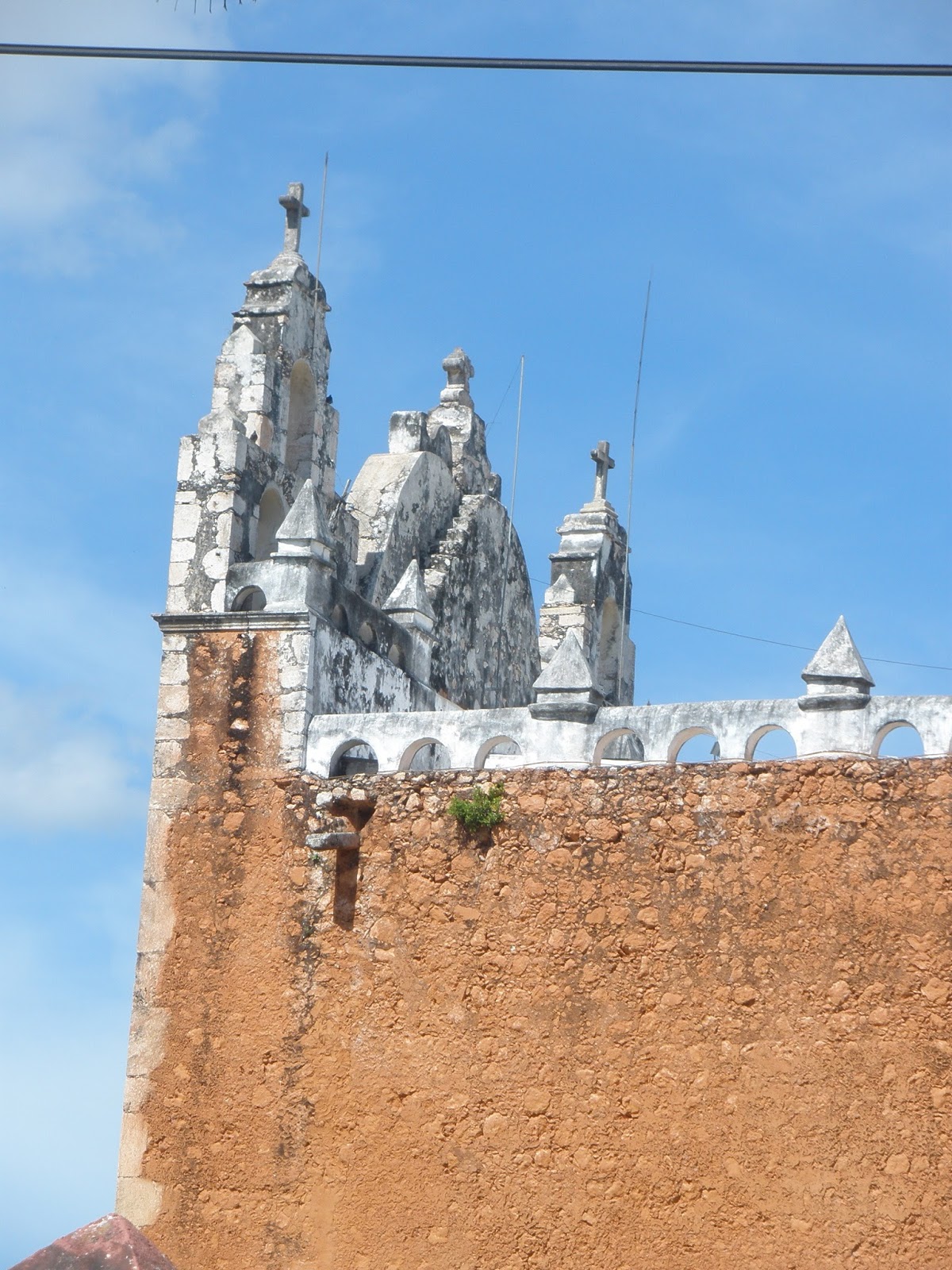
The churches of the Yucatan were all products of the Franciscan effort to christianize the Mayan inhabitants of the region.  They display the characteristic Franciscan architectural simplicity with the exception that nearly all are crowned by espadañas, bell-gables, of varying complexity. Espadaña comes from the Spanish verb espadañar which means to fan out like tail feathers and it is not hard to imagine these bell-gables as having this quality.

Espadañas not unique to the Yucatan, although they have become the signature component of its churches.  They are cheaper and easier to build than a church tower or bell-tower, which was important in an area like the Yucatan which was poor compared to gold-rich central Mexico. The elaborate churches found in that area were not an economic possibility in the Yucatan.  In Spain espadañas are common in small village churches which cannot afford to build a more elaborate bell-tower.

Espadañas added architectural spice to the otherwise plain Franciscan-style  churches of the Yucatan.  They were what provided individuality to each community's church with no two exactly alike and add a great deal if personality to the architecture. Take a look at this sampling of Yucatan churches and you will see what I mean.


Chumayel, Yucatan


Mama, Yucatan
This church in Mama, Yucatan, dedicated to the Virgin of the Assumption. is a good example of how these unique and elaborate facades were built. The church began as a small shrine in the 16th century, expanded in the 17th and in the 18th century, the triple-tier espadaña was added to it.  


Santiago Church, Merida, Yucatan

San Antonio de Padua Church, Ticul,  Yucatan


Ticul Church profile view
Uayma, Yucatan, close up of espedaña


Dzitas, Yucatan
Tunkas, Yucatan


Sitilpech, Yucatan
San Francisco Church, Campeche, Yucatan
These eleven churches with their unique espadaña fingerprints are just a sampling of the churches of the Yucatan.  Most of them, like the church in Mama, evolved from simple buildings being added to in stages with the elaborate bell-gable, the espadaña,  being added last.  Architecturally, these espadañas are a later development reflecting the growth of the Spanish ultra-baroque ornamental chirrugueresque style in the 18th century. 

 Art historian Samuel Edgerton contends that the espadañas also contain a Mayan component, being evocative of the dovecotes (holes for nesting birds)  that sat atop some Mayan temples.  His thought is that, for this reason, the espadaña form resonated with the Mayans for whom and by whom these churches were built.  Perhaps, in some ineffable way, the espadañas made them feel more "at home" within the new faith and its houses of worship. 


Uxmal ruins, Yucatan

Tuesday, July 2, 2013

Tihosuco, San Martiniano: The "Other" Mayan Ruins

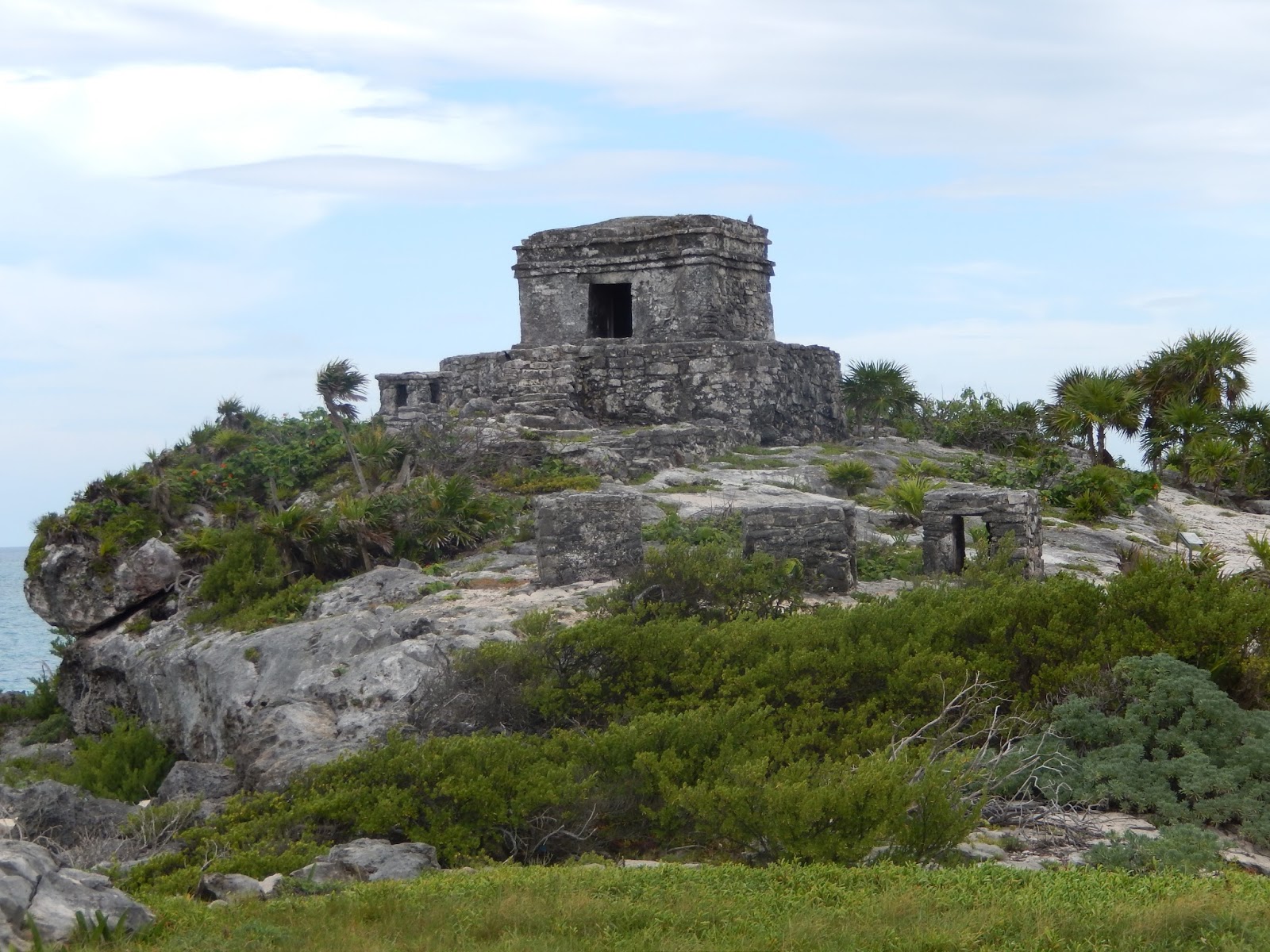
Like the rest of Mexico the state of Quintana Roo, located in the eastern portion of the Yucatan Peninsula and bordered by the Caribbean Sea, is known for its ruins.  The ruins of Tulum,  which in its time was the main port for the inland Mayan city of Coba, are always full of tourists from all over the globe.   With its location alongside the turquoise blue waters of the Caribbean Tulum, historic value apart, is flat-out beautiful.  Coba, located further inland, is a very different sort of site. It is an extensive ruin that is well-visited, as are all the Mayan ruins in Quintana Roo and the rest of the Yucatan.  


Tulum, Quintana Roo, MX

Tulum, Quintana Roo, MX

Coba, Quintana Roo, MX

Coba, Quintana Roo, MX


Then, there are the "other" Mayan ruins, products of a different time in Yucatan history, but equally interesting and equally important.  A major event in the history of the Yucatan was the Caste War, Guerra de las Castas,  which started in the mid-nineteenth century but was not really finished until  the early 20th century.  It began as a Mayan uprising against the Spanish overlords and ultimately resulted  in the independent state of Quintana Roo in 1974.


Tihosuco, Quintana Roo, MX
From the outside the Church of the Divine Child in Tihosuco looks abandoned but, in fact, the interior has been partially reconstructed and it is in use as a church.  Prior to the Caste War, there had been some deterioration in the building, but during this war the church was intentionally destroyed by the uprising Mayans. Fortunately not all of the gunpowder in the keg that was meant to level the church exploded and the church was not totally demolished.

There is little information about the destruction of the old Guadalupe church in San Martiniano which is in a small pueblo not far from Puerto Morelos. I have been told that the church fell apart due to neglect over the years and now the ruins, apart from the facade seen below,  are being torn down to construct a new church that is a reproduction of the original one.


 San Martiniano, Quintana Roo, MX


 San Martiniano, Quintana Roo, MX

At the present time the church in Tihosuco as well as the one in San Martiniano  are functioning as churches  with active congregations.  Each will be explored in-depth in a coming post, but here are a few photos of their interiors.

Interior of San Martiniano church ruin


Interior of Tihosuco church ruin
Neither of these church ruins has the antiquity of Tulum, Coba or the other Mayan ruins, but they both are Mayan ruins of a different sort.  The histories that led to them are fascinating and complex and no less a part of the formation of the contemporary Mayan people of Quintana Roo than the pre-Hispanic period.

Thursday, June 20, 2013

Nuestra Señora de los Remedios, Nuestra Señora de la Soledad: Beloved Statues, Beloved Ladies

Although both of these figures are statues,  "statue" is not really the appropriate word to describe Nuestra Señora de los Remedios and La Virgen de la Soledad.  In so many ways both of them are alive for the people who love and worship them and their legends claim a kind of life and history for both.


Nuestra Señora de los Remedios
  
Virgen de la Soledad 

It is difficult for outsiders to understand the depth of relationship that believers have with these statues.  They dress them, physically care for them and the relationships they have with them are transactional ones in which they ask for and seem to receive answers for their requests.  In the past,  figures similar to these have been almost family members and could be legally inherited  as a part of an estate.  They are less statues than living beings and as French anthropologist Serge Gruzinski has pointed out, in many ways, they are like the original indigenous "idols"  that the Catholic Spanish tried so hard to destroy in the early years of the Conquest.  With the Catholic counter-reformation in Europe which began in the mid-16th century, the Church began to promote the use of images including statues and the situation changed. 

Both of these Virgins have, as is almost always the case with miraculous images,  a very interesting pre-history.  Each appeared without human intervention and although the details differ, there is this basic theme.  Nuestra Señora de los Remedios (Remedies) arrived in the Americas undetected within the habit of a friar.  This friar had been assigned to come to Mexico and when he boarded his ship he felt a weight within his habit, exploring which turned out to be the statue (Remedios is a small figure).  Fearing he would be accused of stealing the statue, he got off the ship and replaced the Virgin in her sanctuary.  When he once again sailed at a later date, he again felt a weight within his habit and, again, it was Remedios; this time he went ahead and sailed, bringing the statue to the New World.  Virgen de la Soledad (Solitude because after Jesus and Joseph died, Mary was alone) appeared one day in 1543 in a box of shoes on the back of a mule; a church was built on this site.

Church of Nuestra Senora de los Remedios, Cholula, Puebla, MX
This church, built 1574-75 and consecrated in 1629, sits on top of a huge pyramid dedicated to Quetzalcoatl. The site was initially chosen because it was customary in the early post-conquest days to put churches on top of pre-Columbian holy sites and the presence of one within the hill was suspected.  There was no confirmation of this until the 1930's when excavation began. This church and the pyramid on which it sits have subsequently become quite famous.   In terms of tourism, much more attention has been focused on this enormous pyramid than the church-sanctuary of Nuestra Senora de los Remedios.  No photography is allowed in the church, but I managed to shoot a few images from the outside.
  
Nuestra Señora de los Remedios, facade of church

Interior of Church
View of Altar showing Nuestra Señora de los Remedios

View of Statue 
View showing elevation of church

The view from the Remedios Church is spectacular because of the elevation of the 

place.The pyramid on which it sits is huge and considered to be the largest in Latin 
America. Tours focus on the pyramid and the entire excavated area which is extensive 
with further excavations planned.


Basilica of  Virgen de la Soledad, Oaxaca
 In contrast with the Church of Nuestra Señora de los Remedios, which is historically significant, but tucked away on the top of a hill/pyramid,  the Basilica of the Nuestra Señora  de la Soledad, built in-between 1682 and 1717,  is one of the two major churches in the city of Oaxaca. This stunning example of Oaxacan Baroque architecture (see April 16, 2013 post of this blog) is central in the religious and communal life of the city and its status as a Basilica designates it as a pilgrimage site and accords it a special status.  


Basilica de la Virgen de la Soledad, interior


Nuestra Señora de la Soledad is, in many ways,  the emblem of Oaxaca   She is not just revered in the city of Oaxaca, but throughout the state and has importance regionally.  The figure below is found in the beautiful church of San Jeronimo Tlacochuaya in a village about a half-hour outside of Oaxaca city.

Soledad in San Jeronimo Talcochuaya


Soldedad was my introduction to Oaxaca.  On my very first night  in the city I saw a young girl dancing in the main square  holding a figure above her head.  This figure, as I was to discover, was Nuestra Señora de la Soledad who apparently has found a niche in the commercial as well as the religious life of the city. 


Girl dancing with figure of Virgen de la Soledad in Zocalo of Oaxaca


Wednesday, June 12, 2013

Huejotzingo: Stone That Taught


Huejotzingo street-view against slopes of volcano Popocatépetl
The monastery of San Miguel Arcangel or St. Michael the Archangel is located in Huejotzingo, a municipality some 40 minutes away from the city of Puebla.  The drive
 there offers spectacular views of two volcanoes, the famous and active Popocatépetl and  Iztaccihuatl.  From this point on, I will use the term "Huejotzingo" to refer to the monastery.


Huejotzingo

Huejotzingo is the oldest  church-convent complex outside of the Valley of Mexico, having been started  in 1529.  Its founding friars were among the  "Twelve", the first wave of Franciscans sent to the New World to begin the evangelization of the indigenous population.  This number twelve was symbolic and meant to evoke the twelve apostles of Jesus;  these friars were no less serious about spreading the faith than the initial twelve apostles had been.  As they understood it, It was their bounden spiritual duty to save the souls of the untaught indigenous, keeping them from eternal damnation  and readying the world for the Second Coming of Christ which required that all the peoples of the world be converted.   

The Huejotizingo complex that now stands is not the original structure, but rather the
 third. The first stood from 1524-1529,  the current complex was begun in 1544 and completed in 1570 under the supervision of Fray Juan de Alameda who initiated the entire project. It consists of a crenellated wall that encloses the complex, the church, the convent and four posa chapels, which will be discussed at more length later.


Interior view of convent wall showing crenellation and Posa  chapel

Huejotzingo, along with the other early monasteries was one of what have been called "fortress monasteries" because of their resemblance to European citadels.  There has been debate about whether they were ever actually intended for protection or whether the fortress-like appearance had other purposes. One interpretation is that they symbolized the Franciscan's self-concept a soldiers of God and another researcher demonstrates that the crenellations had been embedded with acoustical devices that amplified the sound and added a chime-like background sound as well.  


San Miguel Arcangel Church, Huejotzingo

Same church behind cross in atrium (not the original atrial cross, which is in town square)


The posa chapels of Huejotzingo (coming from the Spanish verb posar, to pause) are one of two sets in Mexico that still exist in their entirety.  There are four posa chapels, one in each corner of the wall that surrounds the atrium.  In other monasteries, there may be one or two posas still standing, but in Huejotzingo all four remain.  These posa chapels are a distinct feature of Colonial Mexican architecture and served a  purpose in the evangelization. 


Posa  Chapel


The indigenous peoples already had a tradition of religious processions and the Franciscans built upon this with processions on feast days.  These posa chapels were used during these processions as places for pausing for prayers and may have been used at other times as places for teaching.  Each chapel is covered with symbols of the Franciscan order designed to communicate the Christian faith to on-lookers through these symbols. Each of the four posas was dedicated to a different saint: St. John the Baptist, St. Peter and St. Paul, the Ascension of Mary, and St. James the Apostle.  


Posa Chapel


The facade of each posa contained symbols which provided information about the Franciscans and the faith to the newly Christian indigenous.  On the facade of each chapel were the Franciscan cord with tassel, an emblem of either Christ or the Virgin Mary, two angels carrying instruments of the Passion, and symbols of the five wounds of Christ.
The wounds of Christ had a particular resonance with the Franciscan order because St. Francis had received the stigmata of Christ.


Monogram of the Virgin Mary


Angel carrying instrument of Christ's Passion: scourges


Angel carrying instrument of the Passion: Crown of Thorns

Five Wounds of Christ (from church facade)
In the early days of the Conquest and evangelization of Mexico much of the initial worship took place outdoors.  The indigenous converts were accustomed to outdoor worship and the large numbers of them would have made indoor church worship logistically difficult.  The monasteries all had walled atriums which was where the preaching and ceremonies took place and for this reason, the religious symbols on the exterior of the buildings in the monastery complex were important teaching tools.  

Entrances- doors and gates- are important in the symbolism of places and this is very much the case in Huejotzingo.  


Huejotzingo, West Door
 This west door, as seen above, is the main entrance to the church, decorated for a wedding in the above photo.  It's style is mudejar, an architectural style deriving from Andalusia that reflects the Moorish influences in the culture.  


North Door, Portiuncula, Huejotzingo
This north door, the portiuncula, contains much symbolism and to understand it some relevant history needs to be explored.  The "Twelve" original Franciscans who came to Mexico were utopians and understood their mission as re-creating a New Jerusalem among the New World indigenous whom some at that time believed to be a lost tribe of Jews.  The idea of a New Jerusalem is found in the Old Testament and in the book of Revelation and is tied-in with eschatological notions, the ideas about the end of times when all things will be restored.  

The two pillars surrounding this door were very consciously intended to represent the two columns in the ancient Jerusalem temple and the indigenous were aware of this
 symbolism. To enter these doors was to enter into the temple, to enter into the paradise of the New Jerusalem.  Originally there were no hinges on these doors and the doors were not intended to be an entrance, but for processional use.  Now the doors are opened one day a year, August 1 from 12 noon to midnight entering them is used to gain plenary indulgences.

Huejotzingo is known for the murals within its convent.  These represent various saints and members of the Franciscan order.


The "Twelve" Franciscans


Franciscans: six of the original "Twelve Apostles"


Franciscans : six of the original "Twelve Apostles"


Jesus Washing Disciple's Feet


Mythical Creature


Saints


As the founder of the Franciscan order, St. Francis, his symbols and episodes in his life 
were important in the convent.  Below, we have a mural that shows a legendary episode in St. Francis' life in which he appeared to the monks at a chapter meeting flying around the room in a fiery chariot, an episode based in the Old Testament story of Elijah and the chariot of fire. (My thanks to Prof. Jaime Lara for this explanation). 


St. Francis of Assisi in Fiery Chariot


At Huejotzingo the cloister, the portion where the friars lived, is open for viewing. 


Passageway

Friar's Room


Refectory


Monastery Kitchen


The Pereyns Altar

The altarpiece in the church at Huejotzingo is one of only two 16th century altarpieces to survive in Mexico.  It is also unique because it was signed by the Flemish artist Simon Pereyns who executed its paintings. Pereyns, a Mannerist painter, came to Mexico in the 1560's after some time in Peru was a seminal figure in the history of  Latin American painting,  influencing all who came after him. The paintings in the altarpiece shows various saints and scenes from the life of Christ, with Padre Eterno, God the Father, at the very top as is typically the case with altarpieces. This and other altarpieces served as visual Bibles for the newly converted indigenous, telling the written stories through the language of art. 

Huejotzingo gives us an appreciation for the importance of the visual in the evangelization of Mexico and the rest of the Latin American world.  In the absence of a common written language, the early friars drew upon their creativity in finding ways to communicate the essentials of the new Christian faith.

If you want to read further on Huejotzingo, I refer you to: "Mexico's Fortress Monasteries" by Richard Perry and Dr. Jaime Lara's excellent book "City, Temple, Stage" .