Pages

Wednesday, April 19, 2017

Creating an Earthly Paradise: The Huertos of Guatemala and Nicaragua

Huerto, La Merced Church, Antigua, Guatemala
The Holy Week huertos of Antigua, Guatemala are true spectacles with a deep religious and communal significance.   They are created in churches in conjunction with velaciones, portrayals of scenes of Christ's passion and the beautiful sawdust carpets for which Antigua is famous.  (Please remember that all photos enlarge when clicked for better viewing details).

                                                   
Huerto, La Merced Church, Antigua, Guatemala
                                                                                                     

The fruits and vegetables that go into creating the huerto, in English orchard or garden, are donated by church members and neighbors and often are later sold at a reduced price or given away to people who need them.

Huertos symbolize the abundance and redemption that come with the resurrection of Christ on Easter.  There is also some association with the idea of garden, since it was in the Garden of Gethsemane that Jesus prayed during the unfolding of the events leading up to the crucifixion.

The huertos  of Nicaragua are quite different from the geometrical, elaborate ones seen in Guatemala, although the idea of plenty is present in the copious fruit and foodstuffs used to decorate them.   They are open-sided  enclosures constructed out of sticks and covered with palm fronds.  In some places they are filled with fruits and other types of food. The five photos below were taken in Diria and Diriomo, pueblos in the Masaya region outside of Granada.


Building a Huerto, Holy Wednesday,  Dioriomo, Nicaragua


Building a Huerto, Holy Wednesday, Diria Nicaragua


Building a huerto, Diria, Nicaragua


Huerto,  Holy Wednesday, Diria Nicaragua

Huerto, Holy Wednesday, Diria, Nicaragua


In Granada Nicaragua, the huertos were  somewhat different.  They, too, had stick frames covered with palm fronds, but their interiors were less elaborately decorated with foodstuffs. Instead, each was used as a shelter for a holy figure from the church. In some of the booths religious items were being sold- rosaries and small pieces of cloth that were rubbed on the figures and then were worn or carried by people to confer protection on them.


Huerto, Holy Wednesday night, Granada, Nicaragua


Huerto,  Holy Wednesday night, Granada, Nicaragua
                                    
Huerto, Holy Wednesday night, Granada Nicaragua
Huerto, Holy Wednesday night, Granada, Nicaragua

These huertos are built on Holy Wednesday and remain up the following day.  They  provide worshippers an opportunity to be close to the images, these figures of Jesus, Mary and others that are normally on display in a church or carried in procession.  The huertos  provide an environment of intimacy in which people can interact with these figures and receive the spiritual benefits of this.    

Sunday, March 19, 2017

Islamic Influences in Colonial Latin America


San Francisco Acatepec, Puebla, MX
                                          
Bell Tower of San Francisco Acatepec, Puebla MX 
                                              
Colonial Latin American material culture is full of elements that are usually termed Arabic or Islamic.  One instance is the tile-covered façade of the Puebla, Mexico church in the above photo  (please click photo to enlarge).  The Spanish word for these tiles,azulejos,is derived from an Arabic word meaning "polished stone".  

Background:
What typically are termed  "Islamic influences"  in the material culture of colonial Latin America and the mother country, Spain, are really much more than just that.  Spain as a completely Catholic nation has only existed since 1492, when the last bastion of Muslim control, Granada, fell to the forces of the Ferdinand and Isabella.  The reconquista, which began as early as 718 when Christian Asturias opposed the Moors, proceeded and receded piecemeal over the next  seven and a half centuries.  Toledo fell to Catholic forces in 1085 and in 1212 most of what had been Al-Andalus (Islamic Iberia) became Catholic controlled.  

However, even when Muslim rulers were no longer actually in charge, Muslims and their long-standing culture remained in Spain as the dominant cultural aesthetic force.  Arabic had long been the written and spoken lingua franca for citizens of all religions, Jews, Christians and Muslims.  In fact, when Columbus and his crew first landed in Cuba, a crew member used Arabic to try and communicate with the Taino chieftain; it was assumed that Arabic was a universal language.  


Such continuation of the Islamic style can be seen in the church of   San Roman in Toledo. This church was built in the 13th century, well after the 9th century reconquest of Toledo and yet the mudejar influence is clear.  Mudejar style emerged in the 12th century in the Christian areas of Spain and continued to be a strong influence even after Muslims were no longer involved in architecture.


Church of San Roman, Toledo Spain

Compare the form of this Toledo church window to that of the niche in the Fez, Morocco building below.  Arches, such as this horseshoe arch below are a design element in Morocco and throughout the Islamic world.


Niche in building, Fez Morocco


The nunnery, the Royal Convent of Santa Clara in Tordesillas Spain was built in 1363 in an area that was long out of Muslim control.  The architecture is mudejar and the Christian inscriptions in the tile-work are in Arabic.  

Monastery of Santa Clara , Tordesillas Spain


Monastery of Santa Maria la Real de las Huelgas, Spain

The minaret of the Great Mosque of Seville had a notably tall minaret (tower used by muezzin to call faithful to prayer) that was admired by the Castilians when they took 
Seville in 1248.   This minaret was incorporated into the Cathedral of Seville as its bell tower with some redesigning in 1568.
La Giralda, Seville Spain
As it was, there was a kind of dialogue between the old faith (Islam) and the new, conquering faith (Christianity) that was carried out on the level of material culture.  
The victorious Christian Castilians kept and re-used elements of Islamic culture, which had once been the dominant culture of the Iberian Peninsula.


Latin American Examples:  

The Spanish brought their aesthetic styles with their pervasive Islamic residue along with them to the New World.  Craftsmen were imbued with what had been the dominant aesthetic of the Iberian world for so many centuries that it became a part of the vernacular architecture of the New World in Mexico and elsewhere.

Azulejos:


Elaborate geometric tile-work is pervasive in the architecture of the Islamic world, as in this Fez, Morocco building.


Add caption

Notice the similarities in the work of this Puebla, MX church. Throughout Mexico, geometric tile-work is found alongside figural art.  

San Francisco Acatapec, Puebla, MX  

Alfarjes:

The two photos below are of a ceiling in 16th century Oaxacan church, the ex-Convento of Santo Domingo, Yanhuitlán.  The Spanish term for them is artesanado and ceilings like them are found throughout the colonial Latin American world.  They are based on a type of wooden ceiling found in Spanish Moorish architecture; some are more simple, consisting of horizontal wood ceilings structured through beams that can be either plain or ornamental.


Artesanado-Yanhuitlan, Oaxaca MX
                                                                          

 Enclosed Balconies:

Called Mashrabiya in Arabic, these enclosed porches are found throughout the Islamic world to offer privacy to the occupants of a house.  


Fez
Below, the same type of wooden enclosed porch is seen:


Lima
  Interior Patios:

Courtyards are an ancient feature of building design, but the house built around a central patio originated in Greece and was adopted by the Romans. Fully-enclosed patio houses offered privacy to occupants and were functional for cooling and heating. 
Islamic Spain used this style of building and it became the vernacular architectural style in colonial Latin America.


Riyadh interior, Fex Morrocco
House interior, Puebla,MX

Conclusions:

What we today call Islamic architecture is a product of the Muslim conquest in the 7th and 8th centuries.  Elements, Persian, Roman Byzantine and others, from lands conquered formed the basis of the style that came to be known as Islamic.  These elements underwent a further transformation in contact with the North African Moors resulting in the mudejar style of the Iberian peninsula and, later, Spanish colonies. This mudejar had become so entrenched thoughout much of the Iberian Peninsula, that it became the dominant Spanish style even after Islamic Spain no longer existed.                                                                                                                  

Thursday, February 9, 2017

Guadalupe in Paradise


Beachfront, Akumal MX

For most people this is paradise- one of the beautiful beaches that line the Caribbean coast, the "Riviera Maya", of Mexico. This coastal strip of the Mexican state of Quintana Roo  is famous for its pristine beaches, resorts, bars, nightclubs and all varieties of water sports. But there's much more to it than just that and if you look a little further afield, you find a fascinating life that few visitors suspect. That's because the towns of the Riviera Maya, in addition to being watering holes for visiting sybarites, are also home to the people who work there, largely of Mayan origins and devout Catholics with a lively religious life.


Guadalupe decoration on restaurant, Akumal MX

All of Mexico loves the Virgin of Guadalupe, its Patron Saint.  Her feast day, December 12 , is a holiday throughout Mexico and is as important in the smallest pueblo in the state of Quintana Roo as it is in Guadalupe's Basilica in Mexico City,  As with most major saints, her holiday is celebrated for the nine days preceding the actual day, as well. 

Historically, Guadalupe has been a very controversial figure as described previously in this blog. http://colonialmexicoinsideandout.blogspot.com/2014/02/our-lady-of-guadalupe-miracle-or.html    But for Guadalupano's, Catholics devotees of Guadalupe, such issues are irrelevant; she is an absolute reality and a guiding light.  She is a healer and giver of miracles and the pilgrimages made in return for her miracles area are of utmost importance throughout Mexico. 

Preceding December 12:

The celebration of Guadalupe's feast is not only on December 12, but also the preceding nine days.  On these days there are novenas (devotional services) each night. Akumal, where these photos were taken, is one of the resort towns on the Caribbean coast of the Mexican State of Quintana Roo, and here the novenas were held in a private house that had been set up to be a chapel. The novenas included music, singing as well as spoken prayer.


House used for nightly novenas preceding feast of Guadalupe, Akumal MX
   
              
Novena for Guadalupe's feast, Akumal, MX
                                     
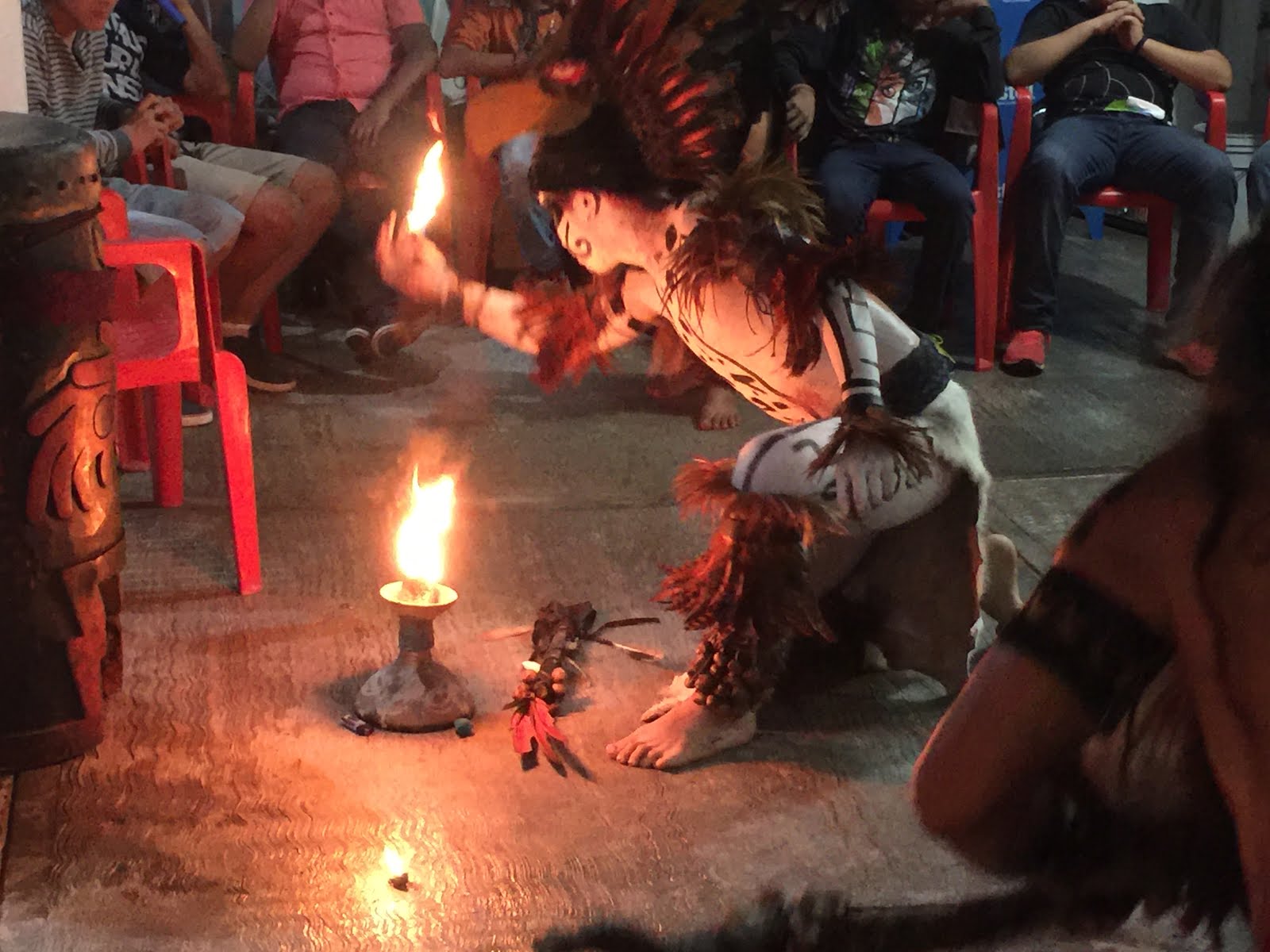
On saints days in Mexico and stemming from Colonial times, there are typically indigenous celebrations of the Catholic saint who is being honored.   The ritual photographed in Akumal, MX was not performed by local people, but by workers living in  Akumal pueblo 
(the workers' quarter) who are from central Mexico. 

                                    
Dancer, Guadalupe celebration, Akumal MX
 The dancers and musicians in the ritual/performance invoked the four cardinal directions, as is customary in Mesoamerican traditions and asked Guadalupe permission to offer dances and music to her. The ritual was very intense and dramatic.

Ritual dedicated to Guadalupe, Akumal MX

The ritual space was demarcated with candles and the copal incense burners which are a  feature of indigenous celebrations throughout Mexico.
                                     
Candles and copal incense burner, Akumal MX

An beautiful altar had been set up with many images of Guadalupe, as well as food offerings to her.                                                                             


Altar to Guadalupe, Akumal MX
                                       
Promesa and Pilgrimmage:

In the days just before December 12, along highways throughout Mexico, you will see vehicles bearing images and altars to Guadalupe.  These include cars, trucks, motorcycles and bicycles.                                                                                                   


Auto with Guadalupe image,near Tulum, Quintana Roo MX
Guadalupano pilgrims, Tulum Quintana Roo, MX
Guadalupano pilgrim, Yucatán, MX

The people in or on these vehicles ,are those who have made promesas to the Virgin of Guadalupe in the previous year.  A promesa is a request made to a saint for some kind of miracle in exchange for which a person makes the promise of a personal sacrifice  when the prayer is answered.  In the case of Guadalupe, the sacrifice is often a pilgrimage.  Some travel to a regional shrine of Guadalupe, such as her Basilica in Mexico City, but in Quintana Roo and Yucatan, the tradition is to travel from the place where you are living and working to the place of your origins and back again.                                                                                                                                                                                                                                                                      


Sign detailing the origins and destination of one family's Promesa, near Tulum, Quintana Roo

The pilgrims walk and the vehicles are, theoretically, only for resting, although it did not appear that all of the pilgrims walked all of the distances.  


Group of Pilgrims, outside of Tulum, Quintana Roo MX
                                                                        
Barefoot Pilgrim, outside of Tulum, Quintana Roo MX

The tradition is that  pilgrims reach their destination by 11 pm on the night of December 12.    There is intense movement along the highways this night as pilgrims rush to reach their destinations.  In various towns, there are rest stops set up for the support of the pilgrims, offering them food and drink such as horchata.  The one below was located on the road about a half-hour outside of Tulum, Quintana Roo.  In this place, there was a tremendous sense of purpose and both the hosts and pilgrims were very open to questions and friendly.

Pilgrims stopping in Macario Gómez, Quintana Roo MX
Pilgrims in Macario Gómez, Quintana Roo MX
Guadalupe Altar set up in Macario Gómez, Quintana Roo MX
                                            
Pigrims' car showing origin and destination outside of Tulum, MX
Pilgrims' car showing origin and destination outside of Tulum, MX

Below, in Akumal, Quintana Roo, cars had pulled off the highway onto the beach road to wait for 11:30 when they would form a procession and cross the bridge that leads to the pueblo and its church.

Pilgrim and cars awaiting start of procession into Akumal Pueblo, Akumal MX
Some of the men in the photo below had bicycled from as far away as central Mexico to return to Akumal.

Pilgrims-cyclists awaiting beginning of procession, Akumal MX


This car was decorated for the very dramatic night procession across a bridge into the pueblo, where the church is located. 


Car decorated for Guadalupe procession, Akumal MX

A crowd had already gathered at Akumal pueblo's church for the Mañanitas service that is the religious service for the feast of Guadalupe and begins very early on the morning of December 12.  It is not a formal mass with clergy present, but a popular service led by  music from a mariachi band, and takes its name from the Mexican birthday song, Las Mañanitas, that is sung to Guadalupe on her day.  On December 12, at some point in the day, there is a formal Catholic mass.

Crowd gathered in front of church for Las Mañanitas, Akumal MX
                                         
Church awaiting arrival of pilgrims, Akumal MX

 Pilgrims arrive bearing figures of Guadalupe on their backs; some have ridden on bicycles long distances through Mexico carrying these figures as a part of their promesa.                                     

Pilgrims arriving in front of church, Akumal, MX
   
These pilgrims enter the church and proceed to the altar where they offer flowers to Guadalupe.                                         


Pilgrims processing into church, Akumal MX

The entire front of the church is filled by the flowers that have been offered to Guadalupe.

Guadalupe Altar, Guadalupe Church, Akumal MX


A Child's Point of View:


Guadalupe observance, Akumal MX
These local boys had a custom that seemed to be part observance of Guadalupe and part early-Christmas.  Each evening they would come to the tourist part of town carrying cardboard boxes each containing an image of Guadalupe decorated with tinsel.  They would sing a lengthy song  about Guadalupe, the idea being that listeners would give them some small amount of money in exchange for the song.  When asked, they said that they were saving up for some X-Box games.  It is unclear whether this is a pan-Mexican custom or simply a local custom.