|
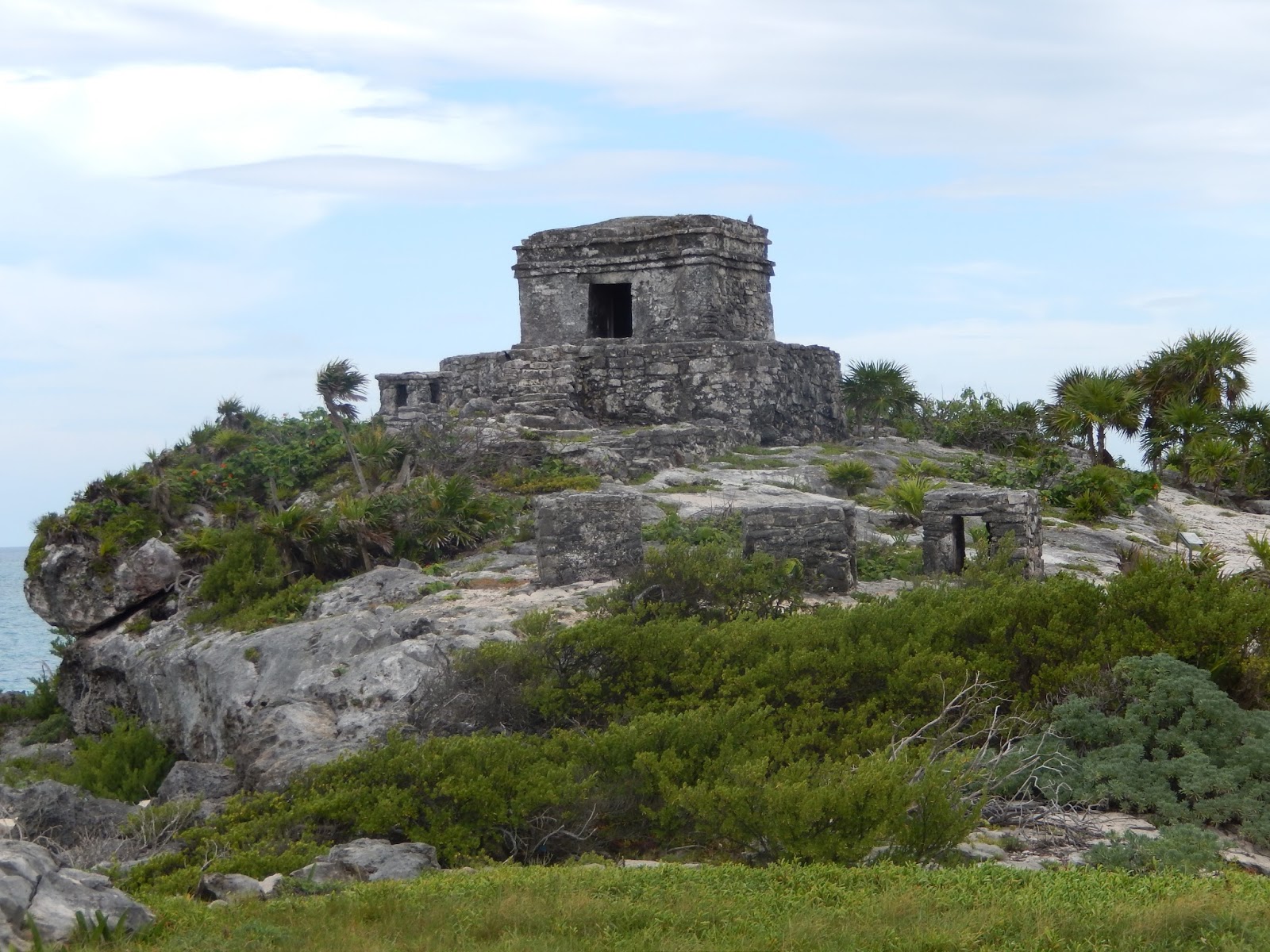
| Shrine to Talking Cross, Felipe Carillo Puerto, Quintana Roo, MX |
History of the "Talking" Cross:
As scholar Nelson Reed pointed out in his classic book, "The Caste War of the Yucatan", it is during times of extreme cultural stress that prophets arise. In 1850 the Mayans were losing the war and their religious structure was falling apart because, in the process of expelling all of Spanish heritage, they also lost their priests with their santos (images/statues of saints). Despite resistance to the Spanish, Catholicism and its trappings had over time become an entrenched part of the Mayan cosmic order and ritual life, the things that kept their world and harvest on track. It was at this time of loss and change that Juan de la Cruz Puc, a man who had been a maestro cantor (one of the former Mayan elite who had been trained by the Catholic priests to perform religious duties) found a small cross fastened to a tree. He had heard the voice of God coming from this tree and it is said that this cross would speak words of encouragement to the struggling Mayans in their military uprising. In time, the number of miraculous crosses rose from one to three which is why, as in the shrine above and in others, three crosses are always shown. De la Cruz claimed that these additional crosses had been found under a leaf near the original tree. Trees were sacred to the Maya and crosses, themselves, pre-dated the coming of Christianity as symbols in the pre-hispanic Mayan world.
These three crosses were described as being dressed in a huipil, an embroidered blouse worn by Mayan women and a skirt. The crosses below are from a present-day roadside shrine in Xcabil, Quintana Roo. They are not "talking crosses" per se, but are crosses dressed in the typical Mayan style similar to the way the "talking crosses" might have been attired.
 |
| Contemporary Mayan dressed crosses |
The crosses below are on the altar of a church on Cozumel, which in pre-Columbian
times had been the site of an important Mayan shrine. Again, these contemporary dressed Mayan crosses are not talking crosses or replicas of the ones from the Caste War period, but are reflections of the Mayan customs that live on in the present day.
 |
| Cozumel, Quintana Roo, Catholic Church altar |
Chan Santa Cruz:
In Chan Santa Cruz, now called Felipe Carillo Puerto, a cult organized around the miraculous crosses developed. A town grew up around the sanctuary to the crosses and around 1858 construction was begun, using the labor of captured whites, on a major shrine to house the Talking Cross and serve as the center of its cult. When the Mayans were finally defeated by the Mexican Army in 1901, the original talking cross, according to reports, was burned.
This building was originally called Balam Na, the House of the Jaguar, and in it were held the services of and sacrifices to the talking cross. The cross was given water and food and today, in some places, there are still communicating objects (crosses included) that are fed and watered. Today the Balam Na it is a Catholic church, named Iglesia de la Santa Cruz, the Church of the Holy Cross. A video of this church can be seen at http://www.youtube.com/watch?v=T1ecIGPKpI4. (link is clickable)
 |
| Balam Na, Felipe Carillo Puerto, Quintana Roo, MX |
 |
| Interior of Iglesia de la Santa Cruz/Church of the Holy Cross |
Notice the size and centrality of the cross in the altar area of the photo above. Among the followers of the Talking Cross in Caste War times, known as the Cruzob or Cruzoob, the Cross itself became a saint and this has persisted into modern times. This church is called the Church of the Holy Cross and although it is a purely Roman Catholic church, it bears the memory of past times and perhaps the importance of a different Cross. The population of Felipe Carillo Puerto is Mayan and certainly the significance of the Talking Cross has not been eradicated from memory.
Mayan Sanctuaries/Mayan Church:
During the period of the Caste War, because all white Mexicans had been driven out, there were no Catholic priests (apart from an occasional captured one) in the zone controlled by the rebel Mayans. Yet, components of Catholicism, in particular the saints (santos in Spanish), had become an important in Mayan life because they were an essential component of their annual ritual cycle, harvest rituals in particular. The
followers of the cross, the Cruzob Mayans, began their own church and ordained men, most likely the maestro cantors, the men trained by the Spanish as religious assistants who knew the Catholic ritual, to be priests. The buildings of this church were homes of the cult of the cross that evolved from the original three "talking crosses". The Cruzob and these sanctuaries still exist and the Mexican Government has legitimated them as well as the institution of the Mayan church. The major sanctuaries are at Tixcacal Guardia, Chancah Veracruz, Chumpón and Tulum and at each one there is this sign on the exterior showing the government's endorsement:
 |
| Sign from Mayan Sanctuary, Felipe Carrillo Puerto, Quintana Roo |
 |
| Sign from Mayan Sanctuary, Felipe Carillo Puerto, Quintana Roo |
During the period of the Caste War, because all white Mexicans had been driven out, there were no Catholic priests (apart from an occasional captured one) in the zone controlled by the rebel Mayans. Yet, components of Catholicism, in particular the saints (santos in Spanish), had become an important in Mayan life because they were an essential component of their annual ritual cycle, harvest rituals in particular. The
followers of the cross, the Cruzob Mayans, began their own church and ordained men, most likely the maestro cantors, the men trained by the Spanish as religious assistants who knew the Catholic ritual, to be priests. The buildings of this church were homes of the cult of the cross that evolved from the original three "talking crosses". The Cruzob and these sanctuaries still exist and the Mexican Government has legitimated them as well as the institution of the Mayan church. The major sanctuaries are at Tixcacal Guardia, Chancah Veracruz, Chumpón and Tulum and at each one there is this sign on the exterior showing the government's endorsement:
 |
| Sanctuario de la Cruz Parlante, Felipe Carillo Puerto, Quintana Roo |
As described earlier in this post, the original sanctuary of the Talking Cross in Chan Santa Cruz/ Felipe Carrillo Puerto (Balam Na) is now a Roman Catholic Church. However, there is also a Mayan Sanctuary in the town and visiting it or any of the other sanctuaries is a fascinating step into another world.
 |
| Mayan Sanctuary, Felipe Carrillo Puerto |
 |
| Side view of above sanctuary |
Visitors absolutely must remove their shoes and hats before entering these sanctuaries and all photography is forbidden. Notice the three crosses in the sign, symbolic of the original three talking crosses, which have come to be an emblem of the Mayan Church and the Cruzob.

The church interior consists of a large open room with seating and a small enclosed area in the front called the Gloria. The Gloria, basically, is the altar but is very private and in some sanctuaries obscured from view with a curtain. At this sanctuary, the altar was open to view and in addition to other objects, there were three crosses dressed in the style of the crosses shown above, as well as a large crucifix with the figure of Jesus hanging on it. There typically is also a flowered arch above the altar table and a smaller table with votive candles and offerings from participants. The religious services in these sanctuaries are called missas (masses) and bear similarities to the Roman Catholic mass. The Mayan priests consider themselves Catholic priests and in at least one of the sanctuaries, masses have been collaboratively celebrated by Roman Catholic and Mayan Catholic priests.
Witnessing one of the missas is a fascinating experience . As I discovered at the sanctuary in Tulum, they tend to be very early in the morning and their time is set by Mayan time which is invariable, being based on the sun, not changing with respect to daylight savings. Observing one of these services requires absolute respect for the boundaries and rules set by the church.
----------------------------------------------------------------------
For those who would like to do some more reading on this very interesting topic, here are a few recommendations:
-Miguel Astor-Aguilera: "The Maya World of Communicating Objects, University of New Mexico Press, 2010.
-John D. Early: "The Maya and Catholicism", University of Florida Press, 2006.
-Nelson A. Reed: "The Caste War of the Yucatan", 2001, (This is the classic book on the Caste War and an easy read)