Pages

Monday, November 21, 2016

Rethinking Thanksgiving


On November 24 of this year millions of people in the US will sit down to the feast of Thanksgiving.  Seemingly there is nothing more all- American than this holiday which has its roots in the Pilgrims' harvest celebration.   Yet, we owe a debt  to Colonial Mexico for this celebration and for the Pilgrims' very survival in their new land.

I wrote about this topic last year, so if you missed it and would like to learn about Colonial Mexico's very serendipitous role in the first Thanksgiving, please click on this link:   http://colonialmexicoinsideandout.blogspot.com/2015/12/colonial-spain-and-first-thanksgiving.html

Happy Thanksgiving!


Wednesday, October 19, 2016

Dia de los Muertos Retrospective

Everyone in the US seems to have been more than ready for Halloween for quite a while.  Although Dia de los Muertos, the Days of the Dead, in Mexico and other Latin American countries are technically November 1 and 2, the holiday has extended itself to incorporate Halloween complete with trick or treating the night of October 31.

Market, Playa del Carmen, Quintana Roo MX
                                       
Halloween Night, San Cristobal de las Casas Chiapas

                                 
Dia de los Muertos is one of the most dramatic and beautiful times in Latin America and I am re-posting a number of pieces and videos I have done over the past few years as an opportunity for those who have not seen them to see the poignant beauty of this holiday.

This video that I shot in San Juan Chamula is one of a kind, since videos are not normally permitted in this locale :https://youtu.be/Vg_1bTFIi1g.  A second video shot in the cemetery of Cristobal de las Casas Chiapas shows a typical celebration of the day in the city's Pantéon:
https://youtu.be/np9YteLYljE. A third took place in the magnificent cemetery of Romerillo Chiapas:  https://youtu.be/t0djWi91TKs

Please also take a look at previous posts of this blog:  
November 12, 2013, November 18, 2014, November 27, 2015.
You can easily access them in the blog archive on the Home page.

Personally, I can never get enough of this dramatic holiday and, of course, when I return from Mexico in November will be writing about it, once again.

Monday, October 10, 2016

Chinese Madonna in a Portuguese Colonial Church: Macau


St. Francis Church in Macau was built in the early 20th century in the baroque style typical of Portuguese Colonial architecture. Macau, on the southern coast of China was a Portuguese possession from the mid-16th century until 1999 when it was turned over to China, It still maintains characteristics of its Iberian heritage but is very Chinese, as well.  In the main city of Macau, there are other colonial-era churches, including St. Dominic's whose construction, completed in 1587, was overseen by three Dominicans from Acapulco, Mexico. At that time there was still a strong connection between the Spanish kingdoms and that of Portugal.  

Words like "quirky" have been used in tourist materials to describe this small church located in a small fishing village on the south coast of Macau and its' interior is not what one would expect from the polished Baroque exterior.  Instead of the elaborate altar-pieces typical of Iberian colonial churches, the altars are hand-painted in a way that is local and reveals the profound devotion of the place.

(Please note that all photos enlarge when clicked).


Nave and Front Altar, St. Francis Church, Coloane Macau

                                             
Side Altar, St. Francis Church, Coloane Macau

                                                       
Side Altar, St. Francis Church, Coloane Macua

St. Francis Church is small but very classic in it's design with a choir loft running the width of the church.  The staircase and back door are quite decorative being painted the bright  yellow and green that are primary colors of the Portuguese flag, as well as having significance within Chinese culture.  In this cultural context, yellow is considered the most beautiful and prestigious color and is the center of everything.  It also signifies good luck, as well as having been the emperor's color in Imperial China. In Buddhism, yellow signifies freedom from worldly cares. Red symbolizes good fortune and joy and green is associated with harmony and health.  Certainly all of these elements go into the prevalent use of these colors here in St. Francis at Coloane and in other Macau churches.

                                           
Choir Loft and Nave rear, St. Francis Church, Coloane Macau
                                       

Church rear interior door, St. Francis Church, Coloane Macau


A small room adjacent to the church is filled with photos and images of importance to the congregation.

Room adjacent to Church,  St. Francis, Coloane Macau

Among these is a unique Madonna and Child that is quite unlike anything seen anywhere else.  Although the subject matter is Christian, the iconography links this Madonna to the larger Buddhist cultural context.  Researchers have said that the Chinese Mary is often connected, in worshippers minds, to the Chinese bodhisattva Guanyin. Bodhisattvas, in Mahayana Buddhism, are people who have achieved spiritual perfection and could get off the wheel of reincarnation, but go on to choose to remain on earth to save others.  In effect, they are gods and goddesses and the term goddess is often used with Guanyin.  In fact, Guanyin is the beloved Goddess of Mercy of China and other south-east Asian lands both within the Buddhist tradition and Taoism, which considers her an Immortal. 

                                                   
Madonna and Child, St. Francis Church, Coloane Macau

The Guanyin below, is from  the Shuanglin Monastery in Quiatou Village near Pingyao, China.  The monastery itself dates from before the 6th century and the figures in it are very old and fragile, which is why they are protected by bars.  Guanyin, here, is seated but like the Virgin floats in the celestial realm and wears a flowing scarf, that is typical of her iconography, as well as that of other divine Buddhist figures.

Guanyin, Shuanglin Temple, Quiaton Village, China

                                   
 The three Arhats below, guardians of the Buddhist faith, also wear the flowing scarves worn by many divine figures in Chinese Buddhism.


Arhats, Huayan Monastery, Datong China
                                                
Virgin Mary, throughout the colonial world, was a figure who, in different ways, became associated with local older dieties in the process of evangelization and adaptation.  Mexico's Guadalupe was fused with indigenous elements as were the Peruvian Virgins of the Andes, who bore a connection to sacred mountains. In the Macau church, we see a Mary connected with an earlier Buddhist goddess who was and still is at the heart of peoples' worship.


Monday, August 8, 2016

Video of Holy Wednesday in Nandaime, Nicaragua

Holy Wednesday, Nandaime Nicaragua
                                   
Holy Wednesday, Nandaime, Nicaragua
On Wednesday of Holy Week in Nandaime, a small town outside of Granada Nicaragua, an ancient Lenten penitential ritual is, more or less, stood on its head and turned into a half-hour of fun, controlled chaos.  It begins and ends with the sounding of church bells and despite appearances, is a religious event. Experience this lively and fascinating celebration in my video:  https://youtu.be/w2K-8g2M54A


Wednesday, August 3, 2016

Ruta Dominica (Dominican Route) of Oaxaca: San Pedro y San Pablo Teposcolula

San Pedro y San Pablo, Teposcolula Oaxaca


This is the third post in a series about the grand 16 th century Dominican Monasteries of Oaxaca's Mixteca Alta, the mountainous area lying to the northwest of Oaxaca City.  The other two that have been covered are San Juan Bautista Coixtlahuaca (June 8, 2016) and San Juan Yanhuitlan (May 20, 2013).  The car ride to the area is fairly long (11/2 to 2 hours), but the mountainous scenery along the route is striking and the trip can be done in one day.  

The Dominicans arrived in Teposculala from Yanhuitlan in 1538 introducing industries which led to a rapid development of the area, although after 1576 there was a decline in the area due to, among other things, an large epidemic among the indigenous inhabitants.

Monastery Plan:

Atrium:

All monasteries in the New world followed the same basic plan.  Each was located on a large plot of land surrounded by a wall, the atrium, which typically had a cross in the middle of it. Until a monastery's buildings were built, religious services were held in open air in the atrium; the indigenous peoples were accustomed to outdoor worship.

                                        
Teposcolula: Atrial Cross

Teposcolula, Wall enclosing Atrium

                                                 
Open Chapel:

In all new world monasteries, the first structure to go up was the open chapel, built to  evangelize the indigenous peoples who did not have a concept of indoor worship. Scholars believe that open chapels were intentionally built to evoke the prehispanic teocalli, the ancient temples built on top of pyramids, found in prehispanic Mesoamerican cultures. 

 The Teposcolula open chapel, dedicated to John the Baptist, is considered one of the masterpieces of Colonial Spanish architecture.  Likely, modeled on the one in the monastery in Coixtliahuaca,  it was built on a grand scale with a second story and all of it, including its Gothic star vault, has been restored.


Teposcolula, Open Chapel
                                 

Teposcolula, Open Chapel
                                       

Teposcolula, Open Chapel Dome
                                     
Teposcolula, Open Chapel Dome


Teposcolula, Open Chapel altar
                                   

Teposcolula, Open Chapel, showing upper story


              The Church:

Teposcolula, Church Façade

The church was largely rebuilt in the 18th century due to earthquake damage. Although Teposcolula was a Dominican monastery, The façade has representations of both Franciscan and Dominican personages.

Teposcolula Church Façade, Dominican Saint
                                           
Teposcolula Church Façade, St. Clare (Franciscan Nun)


The original altar, dating grin 1581 disappeared and was replaced with a neoclassical altarpiece.


Teposcolula, Church Interior


Teposcolula, Front Altarpiece
                                               
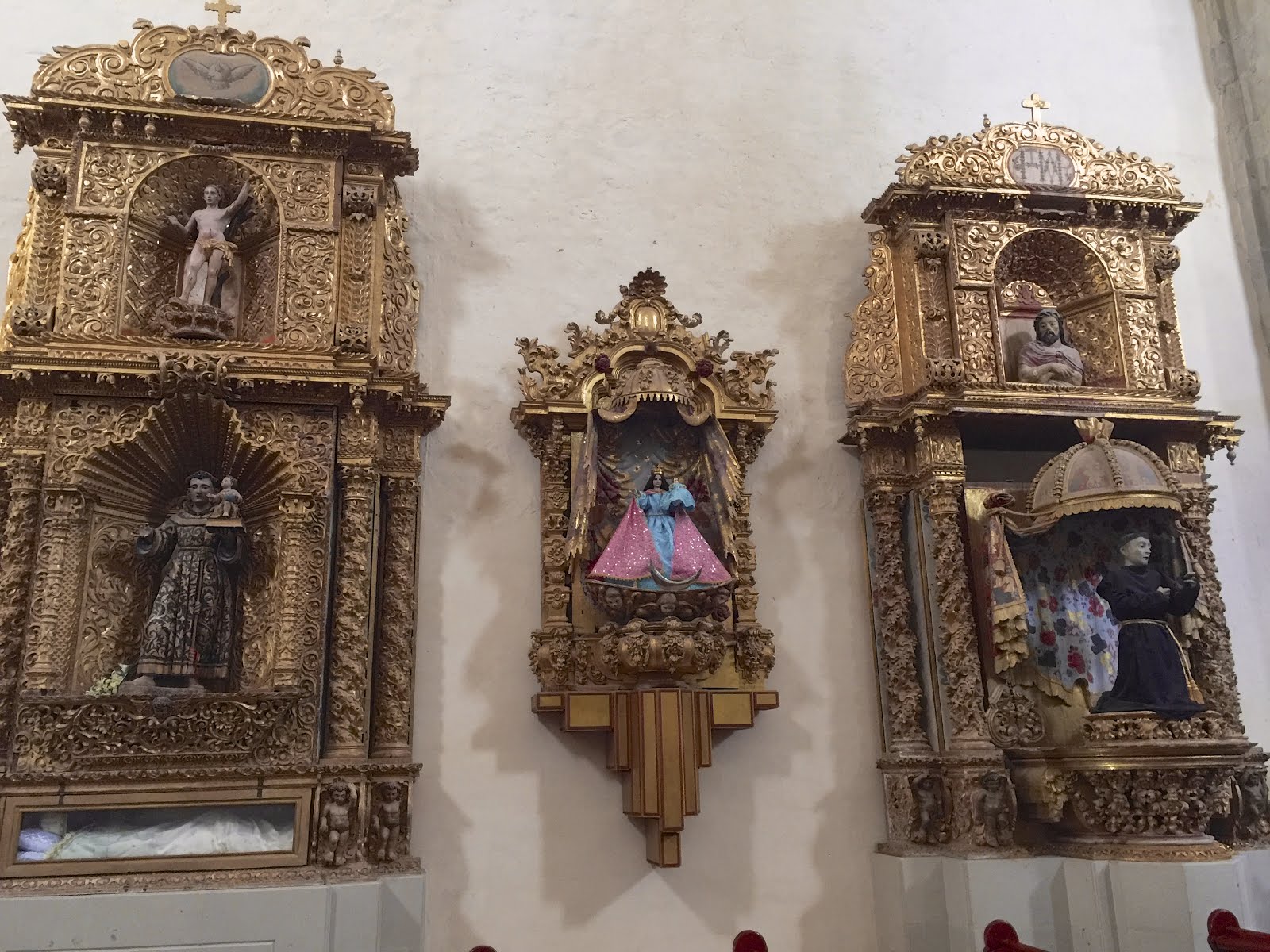
The church has numerous other side altars in styles ranging from neoclassical to baroque.

Teposcolula, Side Altar


Teposcolula, Side Altar


Teposcolula, Side Altar
                                                   

Teposcolula, Side Altar


Teposcolula, Side Altar


Teposcolula, Side Altar
                                   
The church's organ is located high on a side wall of the church toward the rear, an unusual placement for a church organ.  Conceivably, it could be related to the lofts in the open chapel.

Teposcolula, Church Organ

Teposcolula, Church Interior showing placement of Organ
                                               

As in most churches in Oaxaca, there is a characteristic statue of Jesus riding on a donkey, an image derived from Palm Sunday.  
                                   

Teposcolula, Church-Image of Jesus on Donkey


In contrast to the ornamental ceiling in the Coixtlahuaca monastery with its ribbed and painted ceiling, Teposcolula's vaulted ceiling is quite plain, as seen below

Teposcolula, Church Ceiling
                                               

 Representations of the four Evangelists next to the altar dome are a notable for their style. The indigenous hand in their painting is clear and forms a contrast to the European sophistication of the rest of the architecture and decoration.


Teposcolula, Altar Dome
                                             

Teposcolula, Image of San Juan (St. John)


Teposcolula, Image of San Marcos (St. Mark)


The Convento:

The monks' living quarters, the convento, is located adjacent to the church to its right in the photo above, where part of it's entrance can be seen.
Teposcolula church

Teposcolula, Convento Entrance

Teposcolula, Church seen from Convento Courtyard


Teposcolula, Convento Courtyard


Teposcolula, Exterior Passageway and Convento Courtyard


There has been considerable restoration of the convento's interior.  Originally, the interior was ornamentally painted and some of this has been put back into its original condition, which was not the case in Coixtlihuaca.  
                                         
Teposcolula, Convento Staircase
                                  
                             
Teposcolula, Convento Interior Decorative Painting


Teposcolula, Convento Interior Decorative Painting
                                                

Teposcolula, Convento Interior Decorative Painting


The Saint Gertrude Chapel is located in the front of the convento and is said to have been the place where the friars were buried.  


Teposcolula, St. Gertrude Chapel
                                               

Tecpan/ Casa de la Cacica:

Built in the 1560's, this casa de la cacica, house of the indigenous nobility, is the most complete one surviving in Oaxaca and is undergoing restoration at the present time. These palaces for indigenous nobility were built on monastery grounds as a part of the evangelization process.  Typically, local nobility would be the first to convert to Christianity and their presence on monastery grounds was an encouragement for their subjects to follow suit and become Christians. 

                                   
Teposcolula, Tecpan


Teposcolula, Tecpan with Disc Frieze


The disc frieze on the tecpan is in the pre-hispanic style and what it represents has been a source of speculation; some scholars have suggested that it depicts hallucinogenic datura or morning-glory flowers.  Such flowers are found in indigenous-related artwork throughout Mexico. 
                                               ______________________

San Pedro y San Pablo Teposcolula is best visited in conjunction with the monasteries of Yanhuitlan and Coixtlihuaca. Although the three share many architectural features each has a distinct personality and features.  Both Teposcolula and Yanhuitlan have undergone extensive restoration being returned to a pristine state;  Coixtlihuaca has not been restored and retains more of a feeling of authenticity.