Pages

Showing posts with label Guadalupe. Show all posts

Sunday, December 11, 2022

The Feast of Guadalupe Returns Full Force

Lighted image of Guadalupe, Akumal MX
                                                             

In 2020 and 2021 all activities in Mexico, including religious ones,  were limited because of the pandemic.  This year they have mostly returned to their pre-covid form,  including the feast of Guadalupe patron saint of Mexico.  There are some new regulations such as the requirement to wear masks inside Guadalupe's main basilica in Mexico City, but the traditional observances are back.  The return of this beloved celebration is expected to draw record crowds, which does pose logistical problems, as laid out in these two articles.   

https://mexiconewsdaily.com/news/basilica-of-our-lady-of-guadalupe-in-mexico-city-anticipates-record-number-of-pilgrims/      

https://mexiconewsdaily.com/culture/guadalupes-pilgrims-an-annual-logistical-challenge-for-the-capital/                                                 


The period right before December 12, the feast day of Guadalupe is a spiritually intense as well as busy one, as pilgrims rush to reach their destinations by the night of December 11.

Car of a Guadalupe pilgrim in Yucatán


Guadalupe pilgrims at a stop along route in  Quintana  Roo, MX


These pre-pandemic articles from this blog offer a unique look at the Guadalupe celebrations  in places far from the Mexico City shrine.  

https://colonialmexicoinsideandout.blogspot.com/2017/02/guadalupe-in-paradise.html 

https://colonialmexicoinsideandout.blogspot.com/2017/12/the-race-for-guadalupe.html


Saturday, March 23, 2019

Yucatán Gold: Churches of Halachó, Yucatán and Sabancuy, Campeche

Chapel, San Mateo Peto Yucatan

Driving across the Yucatán Peninsula you will pass a church in nearly every town.  Many have no identifying signs, such as the small chapel above in San Mateo, a hamlet which lies about halfway in-between Merida and Campeche.  One common denominator is that many of them are painted the bright yellow color that has come to be known as Yucatán Gold.

Sources seem to agree that Maya beliefs are the main reason for the pervasive use of yellow. This color was associated with the Sun God as well as being symbolic of corn, a very important component of Maya mythology and believed to be the substance out of which human beings were made. There could be other, pragmatic, factors involved such as ready availability of the pigments that make yellow paint, but this has not written about.

Santiago Apôstol, Halachô, Yucatan and Sagrada Corazón de Jesus, Sabancuy Campeche and are both examples of rural Yucatan peninsula church architecture, far more simple than the baroque design found in urban centers.

Santiago Apóstol, Halachó Yucátan:


Santiago Apôstol, Halachô, Yucatan

This church has roots that date back to 1635 when a small chapel was built on the site that it now occupies. The actual church was begun in the late 17th to early 18th century. One of its bells bears the date 1728 and the baptismal font is dated 1739.  Santiago Apostól Church suffered some damage during the fighting of the revolutionary movement of 1915.


Church Front View, Santiago Apóstol, Halachó, Yucatan

Main Altar dedicated to the apostle, St. James (Santiago), Santiago Apóstol, Halachó, Yucatan
Back View, Santiago Apóstol, Halachó, Yucatan

The church is fairly large and there are a number of side altars and a chapel for adoration of the Sacrament.

Chapel of the Blessed Sacrament, Santiago Apóstol, Halachó, Yucatan
Altar of the Blessed Sacrament, Santiago Apóstol,  Halachó, Yucatan


Guadalupe Altar,  Santiago Apóstol, Halachó, Yucatan


Sagrada Corazon de Jesus, Sabancuy Campeche:


Front Façade, Sagrada Corazon de Jesus, Sabancuy, Campeche
Sagrada Corazon de Jesus, Sabancuy, Campeche


 Sagrada Corazon was built piecemeal over a period time dating back about 200 years. The main hall was built in the 1800's, one tower was built in 1952 and the other in 1994.  In modern times, at one point, it was in a deteriorated  condition, with decaying walls and roof.  Subsequently it has been restored and is now in good condition.

Church Interior, Sagrada Corazon de Jesus,  Sabamcuy. Campeche


Front Altar, Sagrada Corazon de Jesus, Sabancuy, Campeche
View toward rear of Church, Sagrada Corazon de Jesus, Sabancuy, Campeche

The deteriorated roof was replaced with one of corrugated metal.


Corrugated Metal Roof, Sagrada Corazon de Jesus, Sabancuy, Campeche

The Divino Niño Jesus, a common devotion in Mexico and throughout Latin America, stems from devotion to the Christ Child.  The statue of the Divino Niño is that of a young child, although the age portrayed can differ slightly. 


Side Chapel of Divino Niño Jesus, Sagrada Corazon de Jesus, Sabancuy, Campeche

Images of the Trinity in Latin American are unique because they give physical form to what elsewhere is an abstract theological concept.  Here, the Father and the Son are portrayed sitting on a cloud with the Holy Spirit (partly hidden by the light) descending in the form of a bird.


Side Chapel of Holy Trinity, Sagrada Corazon de Jesus,  Sabancuy,  Campeche

In all Roman Catholic churches, the consecrated bread, the Blessed Sacrament, is kept in a special container.  Sometimes this container has it's own chapel, as below, where worshippers can come and pray in the presence of this sacrament.  It is considered among the holiest areas of a church, because, according to some theological perspectives, Christ is  actually physically present in the consecrated bread.

Chapel of the Blessed Sacrament, Sagrada Corazon de Jesus, Sabancuy, Campeche

The states of Yucatan and Campeche both have many churches that exemplify, the elaborate, baroque architecture of the Colonial period in Mexico,  There are also many, many smaller churches that dot the landscape displaying vernacular, local characteristics that are equally as interesting as their urban cousins. 


Wednesday, December 12, 2018

The Feast of Guadalupe

Virgen de Guadalupe
Today, throughout Mexico, is the feast of the Virgin of Guadalupe, its Patron Saint.
The day is observed in many ways, with processions, masses and, in some parts of the country, with long-distance journeys made by individuals to honor a promise made to Guadalupe.  Please click the link to see the unique way in which the day is marked in the state of Quintana Roo on Mexico's Yucatan Peninsula-

https://colonialmexicoinsideandout.blogspot.com/2017/12/the-race-for-guadalupe.html


Thursday, February 9, 2017

Guadalupe in Paradise


Beachfront, Akumal MX

For most people this is paradise- one of the beautiful beaches that line the Caribbean coast, the "Riviera Maya", of Mexico. This coastal strip of the Mexican state of Quintana Roo  is famous for its pristine beaches, resorts, bars, nightclubs and all varieties of water sports. But there's much more to it than just that and if you look a little further afield, you find a fascinating life that few visitors suspect. That's because the towns of the Riviera Maya, in addition to being watering holes for visiting sybarites, are also home to the people who work there, largely of Mayan origins and devout Catholics with a lively religious life.


Guadalupe decoration on restaurant, Akumal MX

All of Mexico loves the Virgin of Guadalupe, its Patron Saint.  Her feast day, December 12 , is a holiday throughout Mexico and is as important in the smallest pueblo in the state of Quintana Roo as it is in Guadalupe's Basilica in Mexico City,  As with most major saints, her holiday is celebrated for the nine days preceding the actual day, as well. 

Historically, Guadalupe has been a very controversial figure as described previously in this blog. http://colonialmexicoinsideandout.blogspot.com/2014/02/our-lady-of-guadalupe-miracle-or.html    But for Guadalupano's, Catholics devotees of Guadalupe, such issues are irrelevant; she is an absolute reality and a guiding light.  She is a healer and giver of miracles and the pilgrimages made in return for her miracles area are of utmost importance throughout Mexico. 

Preceding December 12:

The celebration of Guadalupe's feast is not only on December 12, but also the preceding nine days.  On these days there are novenas (devotional services) each night. Akumal, where these photos were taken, is one of the resort towns on the Caribbean coast of the Mexican State of Quintana Roo, and here the novenas were held in a private house that had been set up to be a chapel. The novenas included music, singing as well as spoken prayer.


House used for nightly novenas preceding feast of Guadalupe, Akumal MX
   
              
Novena for Guadalupe's feast, Akumal, MX
                                     
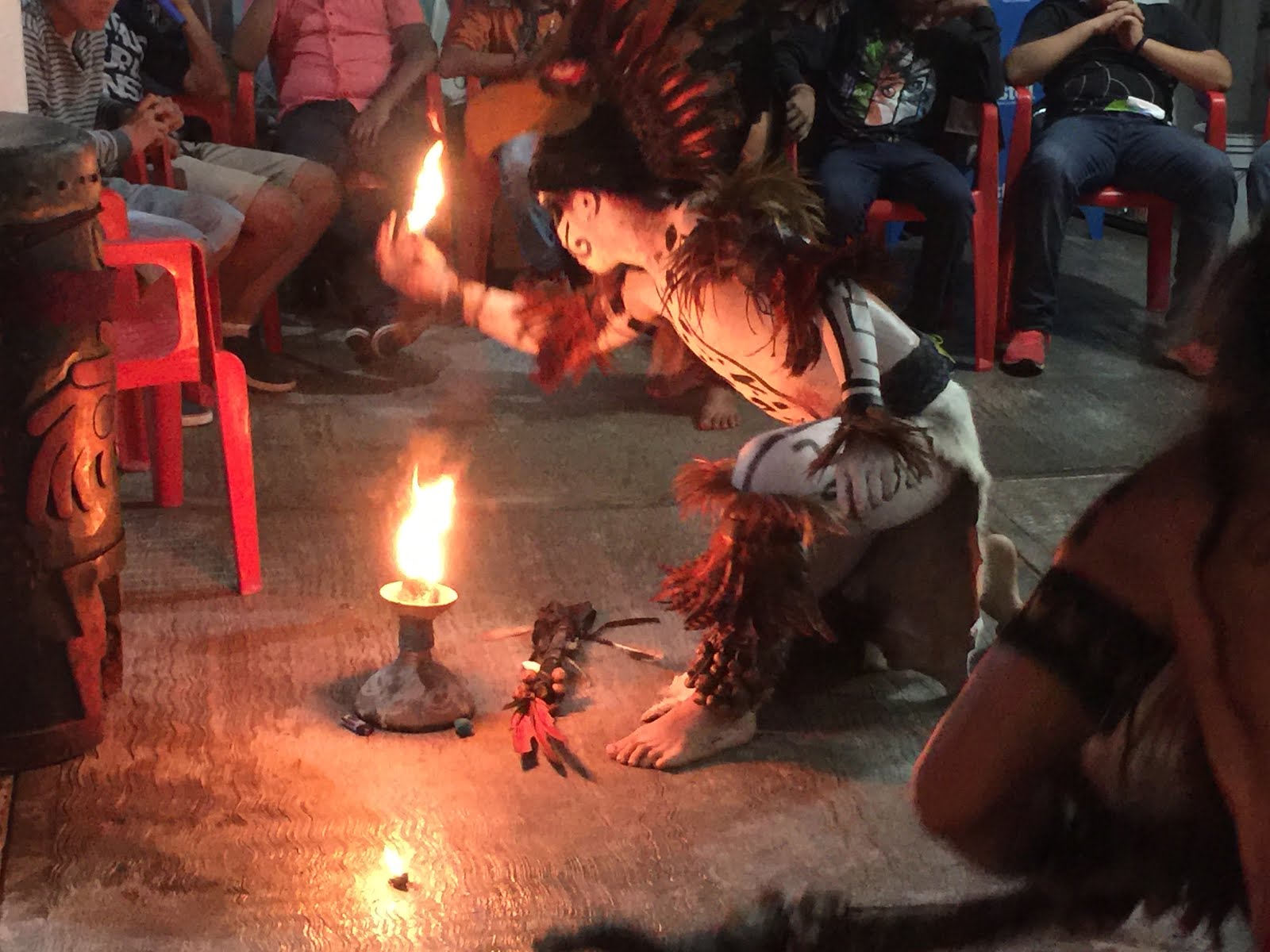
On saints days in Mexico and stemming from Colonial times, there are typically indigenous celebrations of the Catholic saint who is being honored.   The ritual photographed in Akumal, MX was not performed by local people, but by workers living in  Akumal pueblo 
(the workers' quarter) who are from central Mexico. 

                                    
Dancer, Guadalupe celebration, Akumal MX
 The dancers and musicians in the ritual/performance invoked the four cardinal directions, as is customary in Mesoamerican traditions and asked Guadalupe permission to offer dances and music to her. The ritual was very intense and dramatic.

Ritual dedicated to Guadalupe, Akumal MX

The ritual space was demarcated with candles and the copal incense burners which are a  feature of indigenous celebrations throughout Mexico.
                                     
Candles and copal incense burner, Akumal MX

An beautiful altar had been set up with many images of Guadalupe, as well as food offerings to her.                                                                             


Altar to Guadalupe, Akumal MX
                                       
Promesa and Pilgrimmage:

In the days just before December 12, along highways throughout Mexico, you will see vehicles bearing images and altars to Guadalupe.  These include cars, trucks, motorcycles and bicycles.                                                                                                   


Auto with Guadalupe image,near Tulum, Quintana Roo MX
Guadalupano pilgrims, Tulum Quintana Roo, MX
Guadalupano pilgrim, Yucatán, MX

The people in or on these vehicles ,are those who have made promesas to the Virgin of Guadalupe in the previous year.  A promesa is a request made to a saint for some kind of miracle in exchange for which a person makes the promise of a personal sacrifice  when the prayer is answered.  In the case of Guadalupe, the sacrifice is often a pilgrimage.  Some travel to a regional shrine of Guadalupe, such as her Basilica in Mexico City, but in Quintana Roo and Yucatan, the tradition is to travel from the place where you are living and working to the place of your origins and back again.                                                                                                                                                                                                                                                                      


Sign detailing the origins and destination of one family's Promesa, near Tulum, Quintana Roo

The pilgrims walk and the vehicles are, theoretically, only for resting, although it did not appear that all of the pilgrims walked all of the distances.  


Group of Pilgrims, outside of Tulum, Quintana Roo MX
                                                                        
Barefoot Pilgrim, outside of Tulum, Quintana Roo MX

The tradition is that  pilgrims reach their destination by 11 pm on the night of December 12.    There is intense movement along the highways this night as pilgrims rush to reach their destinations.  In various towns, there are rest stops set up for the support of the pilgrims, offering them food and drink such as horchata.  The one below was located on the road about a half-hour outside of Tulum, Quintana Roo.  In this place, there was a tremendous sense of purpose and both the hosts and pilgrims were very open to questions and friendly.

Pilgrims stopping in Macario Gómez, Quintana Roo MX
Pilgrims in Macario Gómez, Quintana Roo MX
Guadalupe Altar set up in Macario Gómez, Quintana Roo MX
                                            
Pigrims' car showing origin and destination outside of Tulum, MX
Pilgrims' car showing origin and destination outside of Tulum, MX

Below, in Akumal, Quintana Roo, cars had pulled off the highway onto the beach road to wait for 11:30 when they would form a procession and cross the bridge that leads to the pueblo and its church.

Pilgrim and cars awaiting start of procession into Akumal Pueblo, Akumal MX
Some of the men in the photo below had bicycled from as far away as central Mexico to return to Akumal.

Pilgrims-cyclists awaiting beginning of procession, Akumal MX


This car was decorated for the very dramatic night procession across a bridge into the pueblo, where the church is located. 


Car decorated for Guadalupe procession, Akumal MX

A crowd had already gathered at Akumal pueblo's church for the Mañanitas service that is the religious service for the feast of Guadalupe and begins very early on the morning of December 12.  It is not a formal mass with clergy present, but a popular service led by  music from a mariachi band, and takes its name from the Mexican birthday song, Las Mañanitas, that is sung to Guadalupe on her day.  On December 12, at some point in the day, there is a formal Catholic mass.

Crowd gathered in front of church for Las Mañanitas, Akumal MX
                                         
Church awaiting arrival of pilgrims, Akumal MX

 Pilgrims arrive bearing figures of Guadalupe on their backs; some have ridden on bicycles long distances through Mexico carrying these figures as a part of their promesa.                                     

Pilgrims arriving in front of church, Akumal, MX
   
These pilgrims enter the church and proceed to the altar where they offer flowers to Guadalupe.                                         


Pilgrims processing into church, Akumal MX

The entire front of the church is filled by the flowers that have been offered to Guadalupe.

Guadalupe Altar, Guadalupe Church, Akumal MX


A Child's Point of View:


Guadalupe observance, Akumal MX
These local boys had a custom that seemed to be part observance of Guadalupe and part early-Christmas.  Each evening they would come to the tourist part of town carrying cardboard boxes each containing an image of Guadalupe decorated with tinsel.  They would sing a lengthy song  about Guadalupe, the idea being that listeners would give them some small amount of money in exchange for the song.  When asked, they said that they were saving up for some X-Box games.  It is unclear whether this is a pan-Mexican custom or simply a local custom.