Pages

Thursday, February 9, 2017

Guadalupe in Paradise


Beachfront, Akumal MX

For most people this is paradise- one of the beautiful beaches that line the Caribbean coast, the "Riviera Maya", of Mexico. This coastal strip of the Mexican state of Quintana Roo  is famous for its pristine beaches, resorts, bars, nightclubs and all varieties of water sports. But there's much more to it than just that and if you look a little further afield, you find a fascinating life that few visitors suspect. That's because the towns of the Riviera Maya, in addition to being watering holes for visiting sybarites, are also home to the people who work there, largely of Mayan origins and devout Catholics with a lively religious life.


Guadalupe decoration on restaurant, Akumal MX

All of Mexico loves the Virgin of Guadalupe, its Patron Saint.  Her feast day, December 12 , is a holiday throughout Mexico and is as important in the smallest pueblo in the state of Quintana Roo as it is in Guadalupe's Basilica in Mexico City,  As with most major saints, her holiday is celebrated for the nine days preceding the actual day, as well. 

Historically, Guadalupe has been a very controversial figure as described previously in this blog. http://colonialmexicoinsideandout.blogspot.com/2014/02/our-lady-of-guadalupe-miracle-or.html    But for Guadalupano's, Catholics devotees of Guadalupe, such issues are irrelevant; she is an absolute reality and a guiding light.  She is a healer and giver of miracles and the pilgrimages made in return for her miracles area are of utmost importance throughout Mexico. 

Preceding December 12:

The celebration of Guadalupe's feast is not only on December 12, but also the preceding nine days.  On these days there are novenas (devotional services) each night. Akumal, where these photos were taken, is one of the resort towns on the Caribbean coast of the Mexican State of Quintana Roo, and here the novenas were held in a private house that had been set up to be a chapel. The novenas included music, singing as well as spoken prayer.


House used for nightly novenas preceding feast of Guadalupe, Akumal MX
   
              
Novena for Guadalupe's feast, Akumal, MX
                                     
On saints days in Mexico and stemming from Colonial times, there are typically indigenous celebrations of the Catholic saint who is being honored.   The ritual photographed in Akumal, MX was not performed by local people, but by workers living in  Akumal pueblo 
(the workers' quarter) who are from central Mexico. 
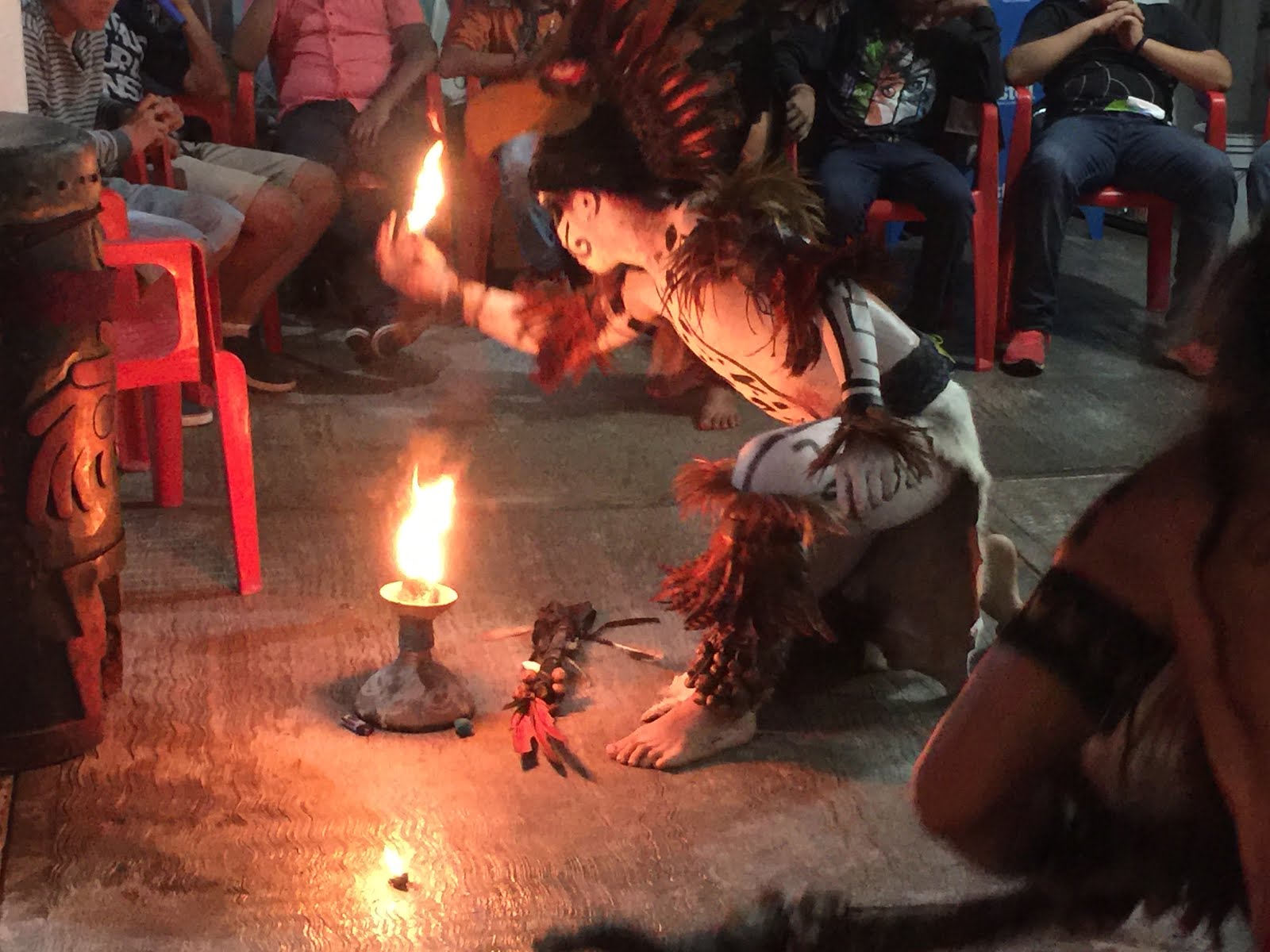
                                    
Dancer, Guadalupe celebration, Akumal MX
 The dancers and musicians in the ritual/performance invoked the four cardinal directions, as is customary in Mesoamerican traditions and asked Guadalupe permission to offer dances and music to her. The ritual was very intense and dramatic.

Ritual dedicated to Guadalupe, Akumal MX

The ritual space was demarcated with candles and the copal incense burners which are a  feature of indigenous celebrations throughout Mexico.
                                     
Candles and copal incense burner, Akumal MX

An beautiful altar had been set up with many images of Guadalupe, as well as food offerings to her.                                                                             


Altar to Guadalupe, Akumal MX
                                       
Promesa and Pilgrimmage:

In the days just before December 12, along highways throughout Mexico, you will see vehicles bearing images and altars to Guadalupe.  These include cars, trucks, motorcycles and bicycles.                                                                                                   


Auto with Guadalupe image,near Tulum, Quintana Roo MX
Guadalupano pilgrims, Tulum Quintana Roo, MX
Guadalupano pilgrim, Yucatán, MX

The people in or on these vehicles ,are those who have made promesas to the Virgin of Guadalupe in the previous year.  A promesa is a request made to a saint for some kind of miracle in exchange for which a person makes the promise of a personal sacrifice  when the prayer is answered.  In the case of Guadalupe, the sacrifice is often a pilgrimage.  Some travel to a regional shrine of Guadalupe, such as her Basilica in Mexico City, but in Quintana Roo and Yucatan, the tradition is to travel from the place where you are living and working to the place of your origins and back again.                                                                                                                                                                                                                                                                      


Sign detailing the origins and destination of one family's Promesa, near Tulum, Quintana Roo

The pilgrims walk and the vehicles are, theoretically, only for resting, although it did not appear that all of the pilgrims walked all of the distances.  


Group of Pilgrims, outside of Tulum, Quintana Roo MX
                                                                        
Barefoot Pilgrim, outside of Tulum, Quintana Roo MX

The tradition is that  pilgrims reach their destination by 11 pm on the night of December 12.    There is intense movement along the highways this night as pilgrims rush to reach their destinations.  In various towns, there are rest stops set up for the support of the pilgrims, offering them food and drink such as horchata.  The one below was located on the road about a half-hour outside of Tulum, Quintana Roo.  In this place, there was a tremendous sense of purpose and both the hosts and pilgrims were very open to questions and friendly.

Pilgrims stopping in Macario Gómez, Quintana Roo MX
Pilgrims in Macario Gómez, Quintana Roo MX
Guadalupe Altar set up in Macario Gómez, Quintana Roo MX
                                            
Pigrims' car showing origin and destination outside of Tulum, MX
Pilgrims' car showing origin and destination outside of Tulum, MX

Below, in Akumal, Quintana Roo, cars had pulled off the highway onto the beach road to wait for 11:30 when they would form a procession and cross the bridge that leads to the pueblo and its church.

Pilgrim and cars awaiting start of procession into Akumal Pueblo, Akumal MX
Some of the men in the photo below had bicycled from as far away as central Mexico to return to Akumal.

Pilgrims-cyclists awaiting beginning of procession, Akumal MX


This car was decorated for the very dramatic night procession across a bridge into the pueblo, where the church is located. 


Car decorated for Guadalupe procession, Akumal MX

A crowd had already gathered at Akumal pueblo's church for the Mañanitas service that is the religious service for the feast of Guadalupe and begins very early on the morning of December 12.  It is not a formal mass with clergy present, but a popular service led by  music from a mariachi band, and takes its name from the Mexican birthday song, Las Mañanitas, that is sung to Guadalupe on her day.  On December 12, at some point in the day, there is a formal Catholic mass.

Crowd gathered in front of church for Las Mañanitas, Akumal MX
                                         
Church awaiting arrival of pilgrims, Akumal MX

 Pilgrims arrive bearing figures of Guadalupe on their backs; some have ridden on bicycles long distances through Mexico carrying these figures as a part of their promesa.                                     

Pilgrims arriving in front of church, Akumal, MX
   
These pilgrims enter the church and proceed to the altar where they offer flowers to Guadalupe.                                         


Pilgrims processing into church, Akumal MX

The entire front of the church is filled by the flowers that have been offered to Guadalupe.

Guadalupe Altar, Guadalupe Church, Akumal MX


A Child's Point of View:


Guadalupe observance, Akumal MX
These local boys had a custom that seemed to be part observance of Guadalupe and part early-Christmas.  Each evening they would come to the tourist part of town carrying cardboard boxes each containing an image of Guadalupe decorated with tinsel.  They would sing a lengthy song  about Guadalupe, the idea being that listeners would give them some small amount of money in exchange for the song.  When asked, they said that they were saving up for some X-Box games.  It is unclear whether this is a pan-Mexican custom or simply a local custom.  


Friday, December 2, 2016

A Dia De Los Muertos You Won't Forget: Pomuch, Campeche

Open grave readied for Dia de los Muertos, Pomuch Campeche, MX
                                     
If one of the psychological purposes of Dia de los Muertos is to bring you face to face with death, there is no better place to do it than Pomuch.  The event in Pomuch, a small town in the Mexican state of Campeche, lacks the sugar-coating of the gorgeous festivities of Oaxaca's famed celebration, but it is a stark reminder of what will eventually happen to all of us.  The Mexican state of Campeche is on the west coast of the Yucatan peninsula and Pomuch is a small town about 50 minutes outside of San Francisco de Campeche, the state's capital.  The uniqueness of its Dia de los Muertos celebration is rooted in the burial practices of the town.

Burial Practices:

 The claim is made that Pomuch has burial practices that are unique in all the world.  

       
Sign at gate of Pomuch cemetery, Pomuch Campeche, MX


As in many places in Mexico and elsewhere, Pomuch's cemetery is small and burial space is at a premium.  Bodies are, initially, buried in full-size tombs, as below.


Full-length grave in Pouch's cemetery, Pomuch Campeche MX

                                            
They are left there for a minimum of three years until they, hopefully, decompose;  sometimes they do not fully decompose, which is strange to see.  After this process, if the space is needed, the bones are consolidated into a small ossuary and put into a smaller tomb.  Some of these smaller spaces are completely closed-in. 


Closed grave in Pomuch's cemetery, Pomuch Campeche, MX


This type of ossuary burial can be seen in many places in Mexico where space is limited. However in Pomuch there is the unique twist that many tombs are open-fronted so that the bones and sometimes hair of the deceased are in plain view. 


Group of open graves in Pomuch's cemetery, Pomuch, Campeche MX
                                    
Cemetery, Pomuch Campeche MX


Open grave, Pomuch, Campeche MZ
                                     

Grave with new embroidered cloth for Dia de los Muertos, Pomuch, Campeche MX
                                                 

Open grave, Pomuch Campeche MX
                                       
Once in a while, for various reasons, a body does not fully-decomposed and when it is disinterred looks more like a mummy than a skeleton. A man working in the cemetery told me that this is due to medications that the deceased had been taking at the time of death; I could not verify this.


Incompletely decompsed skeleton, Pomuch, Campeche, MX


Origins of these Practices:

There is nothing written that I have been able to find about Pomuch's burial practices, apart from fairly sketchy tourism pieces on the internet.  These claim that it is a Mayan custom, which seemed somewhat questionable since the people of the most of the small towns in Campeche are largely of Mayan descent and none of them have this practice of open caskets and the below-described "bone washing"  on Dia de los Muertos.  

There is some interesting and, perhaps, relevant information in a very old book by Fr. Diego de Landa, the 17th century grand-inquisitor of the Yucatan who was responsible for the burning of the Yucatec Mayan Codices in Mani.  Perhaps to make amends for his near-annihilation of written Mayan cultural heritage (just two of these books remain), he wrote a book describing various aspects of the Yucatec Mayan culture at the time of the Conquest.  In it he discussed a certain post-mortem practice in which the bones of the skull were cleaned and the cranium kept on display on a kind of altar.  This would seem relevant to the practices observed in Pomuch, but there is no proof that there is a connection between the two customs.  No one in Pomuch seems to how their burial and Dia de los Muertos "bone-washing" evolved.


Celebrating Dia de los Muertos:

The fact that the ossuaries are open and bones visible is not the crux of Dia de los Muertos in Pomuch- these bones are visible all year round and, contrary to mistaken internet reports, the cemetery in Pomuch is open and accessible 365 days a year, according to the keeper of the town's blog.  What makes it Dia de los Muertos is what is done with these bones.

As you can see, bones are laid in an open box lined with an embroidered cloth.  In October, before the days of the holiday, November 1 and 2, the cloths are changed for new ones and the bones themselves are cleaned.  Again, the internet has it wrong, there is no "bone-washing" as is typically claimed in Pomuch, but a careful brushing of bones by family members.


Woman cleaning grandmother's bones in preparation of Dia de los Muertos, Pomuch, Campeche MX


The woman in the photo was brushing-off the bones of her grandmother.  This cleaning is said to be done to preserve the bones.  It is done matter-of-factly with a kind of intimacy.

Apart from bone-brushing, as throughout Mexico, the graves themselves receive special treatment; the exterior painting is freshened, and flowers placed around and inside the tombs. The cloths that line the caskets are changed for new ones.


Grave readied for Dia de los Muertos, Pomuch, Campeche MX


Grave readied for Dia de los Muertos, Pomuch, Campeche, MX


Grave readied for Dia de los Muertos, Pomuch, Campeche, MX
                                                     

Open grave, readied for Dia de los Muertos, Campeche MZ


A rattle had been touchingly placed in this baby's casket.


Baby's grave, Pomuch, Campeche, MX
                                              

As is customary throughout Mexico, candles are also placed on graves, here among the several caskets in the open tomb.

Open grave, Pomuch, Campeche, MX


Relationship with the Dead:


Gate of Pomuch's Cemetery, Pomuch, Campeche


Throughout Mexico, the spirits are believed to return to visit the earthly realm on the Dias de los Muertos, November 1 for children and November 2 for adults.  Although, on the surface, the holiday is the same in Pomuch as in the rest of Mexico, there seems to be a different kind of relationship to the dead.


Man holding grandmother's bones, Pomuch, Campeche, MX

                                                
The man in the photo above is holding the bones of his grandmother and for him, these bones are his grandmother.  As a child, he said that when he was upset he would come to the cemetery and talk to her (her bones).  

The man below, holding his grandfather's skull,  mirrored these same sentiments. There was no sense of these bones really being dead; they were a part of a once-living and beloved family member.
Man holding grandfather's skull, Pomuch, Campeche, MX

A very old, fragile woman wearing a traditional loose white embroidered dress was walking through the cemetery surrounded and supported by family members. She, apparently had been a teacher and one of her group cheerfully pointed to a casket of bones saying, " He was one of your students."  This is the outlook of people there and there is not a firm line between living person and dead bone, they are both bear the identity of the person to whom they belonged and this does not stop with death.

The people of Pomuch are not death-obsessed.  The town's blog-keeper with whom I corresponded wrote that the cemetery is typically visited primarily in October prior to Dia de los Muertos and on these holidays.  Yet, for some of them, the dead seem closer, more a part of everyday life, than in other locales.   In Pomuch, the graves are open all year long, not just on Dia de los Muertos, and so, in some way, the dead are always there
not just for an annual visit on November 1 or 2.    

Dia de los Muertos and the Human Psyche:

Dia de los Muertos is a holiday with deep psychological significance, in addition to it's ritual and social meaning.  Collectively it is a way for the dead to remain a part of the community of the living and has historical precedents both within Christianity and indigenous beliefs.  Individually, it also has the purpose of helping individuals face and cope with the idea of death, something that is a 100% sure event for all human beings.

In the typical Dia de los Muertos celebration there are pervasive symbols of death.  Altars are built to honor the dead and people paint themselves to look skeletons.


Halloween Night Celebration, Campeche, MX

But there is great deal of difference between looking at someone painted like a skeleton and looking at a real one.


Skeleton, Pomuch Campeche, MX
                                        

The people of Pomuch who choose to have open graves seem very comfortable with the situation and are very matter-of-fact about dealing with the bones of deceased family members.  I asked a few people about their feelings and all of them indicated that they did not see any difference between the bones of a person and the person him or herself.  For the man holding the bones of his grandmother, the bones were his grandmother and everyone questioned answered along the same lines.                                         


Monday, November 21, 2016

Rethinking Thanksgiving


On November 24 of this year millions of people in the US will sit down to the feast of Thanksgiving.  Seemingly there is nothing more all- American than this holiday which has its roots in the Pilgrims' harvest celebration.   Yet, we owe a debt  to Colonial Mexico for this celebration and for the Pilgrims' very survival in their new land.

I wrote about this topic last year, so if you missed it and would like to learn about Colonial Mexico's very serendipitous role in the first Thanksgiving, please click on this link:   http://colonialmexicoinsideandout.blogspot.com/2015/12/colonial-spain-and-first-thanksgiving.html

Happy Thanksgiving!