Pages

Showing posts with label Holy Week. Show all posts

Wednesday, April 8, 2020

The Flagellants of Holy Week: Nandaime, Nicaragua

Medieval Flagellants
In Medieval Spain, as elsewhere, self-flagellation during the period of Lent and Holy Week was a fairly common self-purification practice.  The idea was to drive sin from the body through beating it.  This is still practiced in places, but one of the most interesting variants is found in a little Nicaraguan town called Nandaime on Wednesday of Semana Santa (Holy Week).  Here, the custom is stood on its head with procession participants using their whips and sticks to beat onlookers in a very structured, reasonably safe half-hour event.  

A video I shot on-location in Nandaime a few years ago, shows this unique interpretation of Medieval customs. 

https://www.youtube.com/watch?v=w2K-8g2M54A&t=2s

Friday, May 4, 2018

The Music of Holy Week Processions: Guatemala and Nicaragua (with video)

Float from Holy Week Procession, Granada Nicaragua

Holy Week processions in Latin America are visually phenomenal, but they are more than just beautiful and moving  visual imagery.  Their sounds set the tone and music written especially for these solemn processions is an important part of the pageantry.    Holy Week processional music is funeral music that helps create the somber mood of the impending death of Jesus on Good Friday.   For the most part they are marches that give a sense of drive and movement to the processions. Please watch my video to hear some of this music, as well as see the sights.
 https://www.youtube.com/watch?v=jXAqJQiRP7U&t=18s
Although there are some variations from area to area, the basic musical genre remains the same.

In the video, you saw footage of the Viacrucis Aquatic, a unique water-borne procession of the Way of the Cross on Lake Nicaragua in Granada Nicaragua, The photos below are from this procession and you will notice musical instruments in the second photo, the band for the procession.  They play the distinct funeral marches written specifically for Holy Week  For a more in-depth look at the Viacrucis Aquatic, please visit-https://colonialmexicoinsideandout.blogspot.com/2018/04/via-crucis-aquatic-granada-nicaragua.html


Lead float bearing image of Jesus, Viacrucis Aquatic, Granada Nicaragua

Processional Band, Viacrucis Aquatic, Granada Nicaragua

T

Wednesday, April 11, 2018

Via Crucis Aquatic, Granada Nicaragua: A Totally Unique Holy Week Event

Via Crucis Aquatic, Granada Nicaragua
The Via Crucis, or Way of the Cross, is the series of images (usually 14) showing Jesus on the day of his crucifixion, along with the related prayers.  During the period of Lent and, particularly, on Good Friday there are many Via Crucis processions in Latin American countries. Typically, stations portraying the stations will be set up along streets and pilgrims walk between stations, stopping at each for specific prayers and benedictions.  For those of you that are unfamiliar with this ritual, please click this link for more in-depth information- https://en.wikipedia.org/wiki/Stations_of_the_Cross

Granada, Nicaragua has a totally unique form of the Via Crucis that is performed on the water in small boats and know as Via Crucis Aquatic; it is the only place in Latin America where this is done.  This aquatic Viacrucis happens on Cocibolca (Lake Nicaragua), the largest lake in Central America and is occurs a few times in the week preceding Easter. Hotels and tourist information cannot tell you when they are because there is no set schedule for them.  I was advised to go and inquire at Guadalupe Church, which hosts processions, to find a time and possibly get a ticket.


Guadalupe Church, Granada Nicaragua

The day I went to Guadalupe church, I was lucky, because the office was open and I speak enough Spanish to explain what I was wanted.  I paid a nominal fee and was handed this ticket.


Via Crucis Aquatic ticket
As I later discovered, I had hit the jackpot without knowing it.  The ticket was for the Wednesday before Easter on the lead boat, the one carrying the holy image (imagen) of Jesus Nazareno.  Commercial tours that offer the Via Crucis Aquatic, put tourists in boats that follow the actual water-borne religious procession, but this little purple ticket placed me square in the midst of the procession on the lead boat. Most tourists, if they are lucky, find a boat from which to observe the procession; being a part of the procession, as I was, was  totally different.

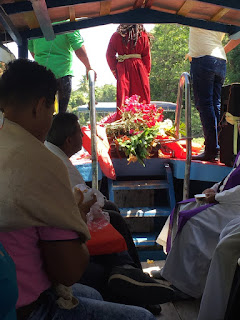
You will notice that the time listed on the ticket was 6:30 am, which meant that I had to be at Guadalupe Church early Wednesday morning. From there the group, mostly congregation members, boarded a van to the lake and our boat.


In van, on the way to the Via Crucis Aquatic

Lake Nicaragua, Cocibolca, is a huge body of water with an outlet to the Atlantic
Granada is located on its shore and in it are 365 small islands (Islets of Granada) located just southeast of the city of Granada; many of them are inhabited either on a full-time or part-time vacation basis. Lake Nicaragua is the largest lake in Central America.


Cocibolca, (Lake Nicaragua), Granada Nicaragua

A band that would play during the Viacrucis procession was already loaded on board and everyone was handed a life jacket for the duration of the nearly 6 hour journey, that would include no bathroom breaks!


Boat readied for Via Crucis Aquatic, Granada Nicaragua
Band instruments on board boat for Via Crucis Aquatic procession, Granada Nicaragua

Below, other boats are loading passengers before taking their place in the procession.


Boats loading for Via Crucis Aquatic, Granada Nicaragua

Because ours was the lead boat, the boat carrying the religious image, members of the clergy came on board to conduct the service.


Clergy on board lead boat, Via Crucis Aquatic, Granada Nicaragua

The boat took off without a statue and at the first island stop, a statue of Jesus Nazareno, the imagen or image referred to on my ticket, was taken from a small chapel where it had been and loaded onto the front of our boat to lead the procession and remain there until the Viacrucis was over hours later. In Latin America significant statues are sometimes lent among churches in a kind of solemn interchange.


Image of Jesus Nazareno being loaded onto Via Crucis Aquatic boat,  Granada Nicaragua
Jesus Nazarene aboard Via Crucis Aquatic, Granada Nicaragua


Here is a photo of me on the boat as the event gets underway; how I managed to have the luck to get on this boat I still do not know.


Author aboard in Via Crucis Aquatic, Granada Nicaragua


The boats in the procession made 14 stops, one for each of the stations of the Cross, each time pulling up at another of the tiny islands, the isletas, that dot Lake Nicaragua.  At each stop, after the prayers,  people offered flowers and fruit to image of Jesus. These offerings were absolutely beautiful and rapidly filled the boat's floor.


Offerings, Via Crucis Aquatic, Granada Nicaragua

The band played frequently throughout the event, often when approaching or leaving a station.  Their music consisted of the funeral marches typical of the area.  These, during the colonization of Latin America, were adapted to military bands that accompanied funerals and so in addition to being sombre have a military feeling as well. They are of a specific musical genre having initially been written by composers with very little musical training.  

Band playing during Via Crucis Aquatic, Granada Nicaragua

There were two kinds of boats out on Cocibolca that day, boats participating in the procession and sight-seeing boats following the processional boats. Below are some of the many tour boats, since the event is a popular one for tourists. Observing the procession and being a part of it are two entirely different things.


Tourist Boats during Via Crucis Aquatic, Lake Nicaragua


Each Station of the Cross had been carefully decorated by the inhabitants of the various islands. 


Station of the Cross, Via Crucis Aquatic, Granada Nicaragua
Station of the Cross, Via Crucis Aquatic Granada Nicaragua
Station of the Cross, Via Crucis Aquatic, Granada NIcaragua
Station of the Cross, Via Crucis Aquatic, Granada Nicaragua

As the procession went along the boat became more and more laden with the offerings that were given by the islanders at each stop.  Some people donated money to the church and there was a designated person onboard to collect it. At the end of the Via Crucis some of the fruit was sold to people on the boat who wanted it and some remained for the church and clergy and to be distributed among the needy.


Flower Offering, Via Crucis Aquatic, Granada Nicaragua


Fruit Offering, Via Crucis Aquatic, Granada Nicaragua


Floral Offering, Via Crucis Aquatic, Granada Nicaragua

At the Via Crucis' end, the statue of Jesus was removed from the boat, to be returned 
to its "home" church in the city.


Jesus Nazareno about to be removed from Via Crucis  Aquatic boat, Granada Nicaragua

Reflections:

All Via Crucis are solemn devotional events, but Granada's Via Crucis Aquatic is more than just that.  It is not only an opportunity for personal devotion for participants, but an celebration that unites Granada and its outlying islands, giving the community a chance to come together in an activity that has meaning for all.  It is a solemn celebration, but also one with much beauty and its own sort of joy. Money is raised for the church and some of the offerings are donated to the needy.   

The Via Crucis Aquatic is a unique experience, and a local mainstay of Holy Week in Granada.  It is offered as a highlight on all tours to the area, even though tourists are advised that there is a chance one may not be available on the day or days they are there.

I plan on making a video of the Via Crucis Aquatic in the near-future.


Friday, March 2, 2018

Good Friday Procession: An Invisible Participant


Semana Santa, Holy Week, is the final week of the church's observance of Lent, the 
40 day (more or less) penitential period of the church leading up to Easter.  In Mexico and all of Latin America, Semana Santa is a major event, marked by religious processions and ritual.  The Holy Week processions of certain places are famous, particularly the world-famous processions of Antigua, Guatemala.  Please follow the links below to see previous posts and videos of some of these:
https://colonialmexicoinsideandout.blogspot.com/2015/04/video-holy-saturday-procession.html   
https://colonialmexicoinsideandout.blogspot.com/2015/04/videos-of-holy-week-in-latin-america.html

As you can see from the videos, processional figures and floats are elaborate and their imagery rich.  The major actors from the biblical accounts of the last week of Jesus' earthly life are represented in beautiful and costly images, as in this float bearing Jesus carrying his cross    


Add caption

However there is one curious exception you will see on Holy Friday in Antigua. In the photos below we see a procession forming at the magnificent early 18th century church of San Francisco el Grande.  There are the incense and standard bearers and some of the clergy in front of the church's magnificent baroque façade.


Good Friday procession, San Francisco church, Antigua Guatemala


A red velvet canopy emerges carried by four men in the traditional hoods that conceal their faces and identities.  There is no image visible under this canopy and it remains empty to our eyes throughout the long procession.  Yet, it leads the procession.


Good Friday procession, San Francisco Church, Antigua Guatemala
The Holy Spirit in procession,  Good Friday procession, Antigua Guatemala

Although the canopy looks empty, to the eyes of faithful believers it is not.
The occupant is the Holy Spirit, the spiritual force that breathed life into being and continues to support creation.  In Christian theology, the Holy Spirit, along with God the Father and Jesus, is one part of the Trinity, a concept that was the end of long theological debate centuries ago. 

In Latin American religious art, the Holy Spirit is typically represented as a bird. This can be seen in both Mexican depictions of the Trinity below.


Holy Trinity, Merida Cathedral, Merida MX
Trinity, Itzimna Church, Merida MX


Another typical Latin American representation of the Trinity is as one of three actual persons, as in this New Mexican santo.

Santo of Holy Trinity by Jose Maria Benavides, New Mexico

Yet, in the Antigua procession, there is no image.  This representation of the Holy Spirit without any image is not seen in many (if any other) Holy Week processions where the focus is on Jesus, Mary, St. John and other central participants in the biblical accounts of the final week of Jesus' earthly life.  It is something unique in the Latin American world, although perhaps there are precedents in Spain where the processions have a longer history, stemming from medieval times.

Wednesday, April 19, 2017

Creating an Earthly Paradise: The Huertos of Guatemala and Nicaragua

Huerto, La Merced Church, Antigua, Guatemala
The Holy Week huertos of Antigua, Guatemala are true spectacles with a deep religious and communal significance.   They are created in churches in conjunction with velaciones, portrayals of scenes of Christ's passion and the beautiful sawdust carpets for which Antigua is famous.  (Please remember that all photos enlarge when clicked for better viewing details).

                                                   
Huerto, La Merced Church, Antigua, Guatemala
                                                                                                     

The fruits and vegetables that go into creating the huerto, in English orchard or garden, are donated by church members and neighbors and often are later sold at a reduced price or given away to people who need them.

Huertos symbolize the abundance and redemption that come with the resurrection of Christ on Easter.  There is also some association with the idea of garden, since it was in the Garden of Gethsemane that Jesus prayed during the unfolding of the events leading up to the crucifixion.

The huertos  of Nicaragua are quite different from the geometrical, elaborate ones seen in Guatemala, although the idea of plenty is present in the copious fruit and foodstuffs used to decorate them.   They are open-sided  enclosures constructed out of sticks and covered with palm fronds.  In some places they are filled with fruits and other types of food. The five photos below were taken in Diria and Diriomo, pueblos in the Masaya region outside of Granada.


Building a Huerto, Holy Wednesday,  Dioriomo, Nicaragua


Building a Huerto, Holy Wednesday, Diria Nicaragua


Building a huerto, Diria, Nicaragua


Huerto,  Holy Wednesday, Diria Nicaragua

Huerto, Holy Wednesday, Diria, Nicaragua


In Granada Nicaragua, the huertos were  somewhat different.  They, too, had stick frames covered with palm fronds, but their interiors were less elaborately decorated with foodstuffs. Instead, each was used as a shelter for a holy figure from the church. In some of the booths religious items were being sold- rosaries and small pieces of cloth that were rubbed on the figures and then were worn or carried by people to confer protection on them.


Huerto, Holy Wednesday night, Granada, Nicaragua


Huerto,  Holy Wednesday night, Granada, Nicaragua
                                    
Huerto, Holy Wednesday night, Granada Nicaragua
Huerto, Holy Wednesday night, Granada, Nicaragua

These huertos are built on Holy Wednesday and remain up the following day.  They  provide worshippers an opportunity to be close to the images, these figures of Jesus, Mary and others that are normally on display in a church or carried in procession.  The huertos  provide an environment of intimacy in which people can interact with these figures and receive the spiritual benefits of this.