Pages

Showing posts with label Franciscans. Show all posts

Wednesday, August 3, 2016

Ruta Dominica (Dominican Route) of Oaxaca: San Pedro y San Pablo Teposcolula

San Pedro y San Pablo, Teposcolula Oaxaca


This is the third post in a series about the grand 16 th century Dominican Monasteries of Oaxaca's Mixteca Alta, the mountainous area lying to the northwest of Oaxaca City.  The other two that have been covered are San Juan Bautista Coixtlahuaca (June 8, 2016) and San Juan Yanhuitlan (May 20, 2013).  The car ride to the area is fairly long (11/2 to 2 hours), but the mountainous scenery along the route is striking and the trip can be done in one day.  

The Dominicans arrived in Teposculala from Yanhuitlan in 1538 introducing industries which led to a rapid development of the area, although after 1576 there was a decline in the area due to, among other things, an large epidemic among the indigenous inhabitants.

Monastery Plan:

Atrium:

All monasteries in the New world followed the same basic plan.  Each was located on a large plot of land surrounded by a wall, the atrium, which typically had a cross in the middle of it. Until a monastery's buildings were built, religious services were held in open air in the atrium; the indigenous peoples were accustomed to outdoor worship.

                                        
Teposcolula: Atrial Cross

Teposcolula, Wall enclosing Atrium

                                                 
Open Chapel:

In all new world monasteries, the first structure to go up was the open chapel, built to  evangelize the indigenous peoples who did not have a concept of indoor worship. Scholars believe that open chapels were intentionally built to evoke the prehispanic teocalli, the ancient temples built on top of pyramids, found in prehispanic Mesoamerican cultures. 

 The Teposcolula open chapel, dedicated to John the Baptist, is considered one of the masterpieces of Colonial Spanish architecture.  Likely, modeled on the one in the monastery in Coixtliahuaca,  it was built on a grand scale with a second story and all of it, including its Gothic star vault, has been restored.


Teposcolula, Open Chapel
                                 

Teposcolula, Open Chapel
                                       

Teposcolula, Open Chapel Dome
                                     
Teposcolula, Open Chapel Dome


Teposcolula, Open Chapel altar
                                   

Teposcolula, Open Chapel, showing upper story


              The Church:

Teposcolula, Church Façade

The church was largely rebuilt in the 18th century due to earthquake damage. Although Teposcolula was a Dominican monastery, The façade has representations of both Franciscan and Dominican personages.

Teposcolula Church Façade, Dominican Saint
                                           
Teposcolula Church Façade, St. Clare (Franciscan Nun)


The original altar, dating grin 1581 disappeared and was replaced with a neoclassical altarpiece.


Teposcolula, Church Interior


Teposcolula, Front Altarpiece
                                               
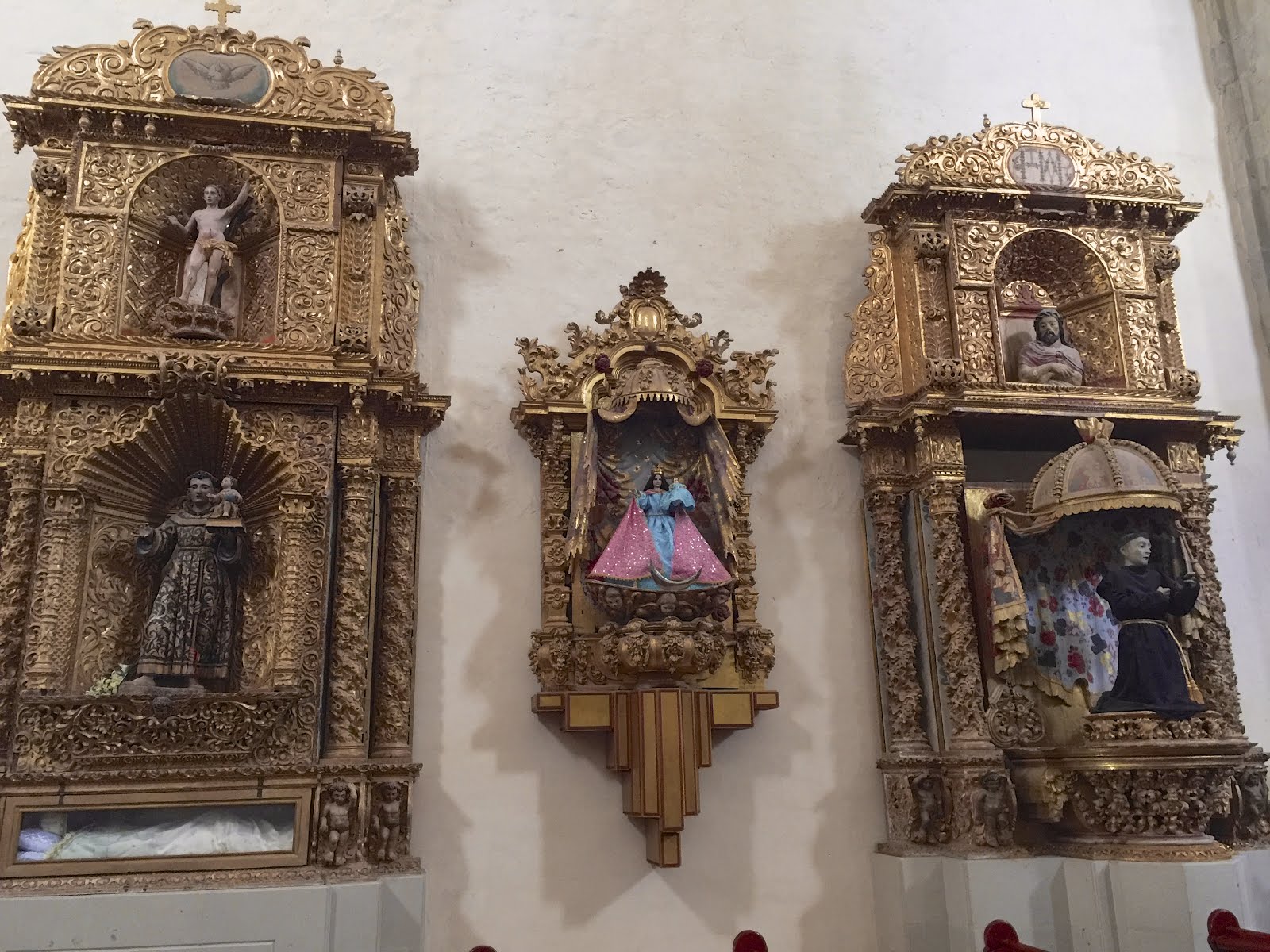
The church has numerous other side altars in styles ranging from neoclassical to baroque.

Teposcolula, Side Altar


Teposcolula, Side Altar


Teposcolula, Side Altar
                                                   

Teposcolula, Side Altar


Teposcolula, Side Altar


Teposcolula, Side Altar
                                   
The church's organ is located high on a side wall of the church toward the rear, an unusual placement for a church organ.  Conceivably, it could be related to the lofts in the open chapel.

Teposcolula, Church Organ

Teposcolula, Church Interior showing placement of Organ
                                               

As in most churches in Oaxaca, there is a characteristic statue of Jesus riding on a donkey, an image derived from Palm Sunday.  
                                   

Teposcolula, Church-Image of Jesus on Donkey


In contrast to the ornamental ceiling in the Coixtlahuaca monastery with its ribbed and painted ceiling, Teposcolula's vaulted ceiling is quite plain, as seen below

Teposcolula, Church Ceiling
                                               

 Representations of the four Evangelists next to the altar dome are a notable for their style. The indigenous hand in their painting is clear and forms a contrast to the European sophistication of the rest of the architecture and decoration.


Teposcolula, Altar Dome
                                             

Teposcolula, Image of San Juan (St. John)


Teposcolula, Image of San Marcos (St. Mark)


The Convento:

The monks' living quarters, the convento, is located adjacent to the church to its right in the photo above, where part of it's entrance can be seen.
Teposcolula church

Teposcolula, Convento Entrance

Teposcolula, Church seen from Convento Courtyard


Teposcolula, Convento Courtyard


Teposcolula, Exterior Passageway and Convento Courtyard


There has been considerable restoration of the convento's interior.  Originally, the interior was ornamentally painted and some of this has been put back into its original condition, which was not the case in Coixtlihuaca.  
                                         
Teposcolula, Convento Staircase
                                  
                             
Teposcolula, Convento Interior Decorative Painting


Teposcolula, Convento Interior Decorative Painting
                                                

Teposcolula, Convento Interior Decorative Painting


The Saint Gertrude Chapel is located in the front of the convento and is said to have been the place where the friars were buried.  


Teposcolula, St. Gertrude Chapel
                                               

Tecpan/ Casa de la Cacica:

Built in the 1560's, this casa de la cacica, house of the indigenous nobility, is the most complete one surviving in Oaxaca and is undergoing restoration at the present time. These palaces for indigenous nobility were built on monastery grounds as a part of the evangelization process.  Typically, local nobility would be the first to convert to Christianity and their presence on monastery grounds was an encouragement for their subjects to follow suit and become Christians. 

                                   
Teposcolula, Tecpan


Teposcolula, Tecpan with Disc Frieze


The disc frieze on the tecpan is in the pre-hispanic style and what it represents has been a source of speculation; some scholars have suggested that it depicts hallucinogenic datura or morning-glory flowers.  Such flowers are found in indigenous-related artwork throughout Mexico. 
                                               ______________________

San Pedro y San Pablo Teposcolula is best visited in conjunction with the monasteries of Yanhuitlan and Coixtlihuaca. Although the three share many architectural features each has a distinct personality and features.  Both Teposcolula and Yanhuitlan have undergone extensive restoration being returned to a pristine state;  Coixtlihuaca has not been restored and retains more of a feeling of authenticity.


Monday, December 21, 2015

Colonial Spain and the First Thanksgiving

 Colonial Spain had a vast influence in North America which is obvious in places like Florida, New Mexico, Texas and California, but it also had an impact in places where you would least suspect it.  One such instance is the United State'sThanksgiving Day, which might never have happened had it not been for a twist of fate involving Spain.


The First Thanksgiving

Every school-child in the United States knows the story of the First Thanksgiving, the harvest feast shared by the Pilgrims with their Indian neighbors. This feast would never have taken place, nor would the Pilgrims have survived in the new Plymouth colony had it not been for Tisquantum, more commonly known as Squanto,  a Patuxet living in what is present-day Plymouth MA.


Tisquantum (Squanto) as imagined by artist

Around 1614 Tisquantum along with 23 others had been abducted by an English profiteer named Thomas Hunt and transported overseas to Malaga, Spain where they were sold to Franciscan friars. Indians were no novelty to the Franciscans of Spain because their order had been working in Mexico since 1524. They accompanied the conquistadors as the "spiritual arm" of the conquest; their job was to convert the newly-discovered natives to Christianity.  They were also humanitarians who fought for the Indians' recognition as full human beings and protected them against the abuses of the Spanish.


Present-day Franciscan Friars in Antigua Guatemala

When the Malaga Franciscans learned that  Tisquantum and his fellow abductees were from American, they instructed them in Christianity and then sent them on their way. The friars were said to have been very irritated by the attempt of Thomas Hunt to make money from their enslavement.   Tisquantum made his way from Malaga to England where he worked for  one John Slaney and learned English.

 John Slaney was the treasurer of the Newfoundland Company and he sent Tisquantum to Newfoundland, to work as a translator with Captain John Mason, governor of the Newfoundland Colony. In 1619 Tisquantum was taken to New England to serve as a translator in an effort to make peace with and reestablish trade with the Indians there, who were his people. However when he arrived in his home territory, they learned that all of his people (the Patuxets), had been killed by a plague (likely small pox) caused by disease brought by the Europeans.

But, as it turned out, there was also a bright side to Tisquantum's 1619 return home.  It was just in time for the Mayflower Pilgrims, who pulled into Provincetown Harbor in November 1620.  The pivotal event occurred on March 22, 1619 when the Pilgrims met Tisquantum, the English-speaking Indian who would be their guide and mentor in this new world. Through him, the  Pilgrims were able to negotiate a peace treaty with the Indians of the area and  establish trading relations, as well as learning methods for cultivating the land. In early autumn of 1621 the 53 surviving Pilgrims, along with their Indian guests, celebrated their successful harvest in the feast that has come to be known as the First Thanksgiving.

The truth is, without the long chain of events involving the earlier Franciscan experience in Mexico and Tisquantum's lucky encounter with the men of this order in Spain, the history of our nation might have been very different.  


Wednesday, June 12, 2013

Huejotzingo: Stone That Taught


Huejotzingo street-view against slopes of volcano Popocatépetl
The monastery of San Miguel Arcangel or St. Michael the Archangel is located in Huejotzingo, a municipality some 40 minutes away from the city of Puebla.  The drive
 there offers spectacular views of two volcanoes, the famous and active Popocatépetl and  Iztaccihuatl.  From this point on, I will use the term "Huejotzingo" to refer to the monastery.


Huejotzingo

Huejotzingo is the oldest  church-convent complex outside of the Valley of Mexico, having been started  in 1529.  Its founding friars were among the  "Twelve", the first wave of Franciscans sent to the New World to begin the evangelization of the indigenous population.  This number twelve was symbolic and meant to evoke the twelve apostles of Jesus;  these friars were no less serious about spreading the faith than the initial twelve apostles had been.  As they understood it, It was their bounden spiritual duty to save the souls of the untaught indigenous, keeping them from eternal damnation  and readying the world for the Second Coming of Christ which required that all the peoples of the world be converted.   

The Huejotizingo complex that now stands is not the original structure, but rather the
 third. The first stood from 1524-1529,  the current complex was begun in 1544 and completed in 1570 under the supervision of Fray Juan de Alameda who initiated the entire project. It consists of a crenellated wall that encloses the complex, the church, the convent and four posa chapels, which will be discussed at more length later.


Interior view of convent wall showing crenellation and Posa  chapel

Huejotzingo, along with the other early monasteries was one of what have been called "fortress monasteries" because of their resemblance to European citadels.  There has been debate about whether they were ever actually intended for protection or whether the fortress-like appearance had other purposes. One interpretation is that they symbolized the Franciscan's self-concept a soldiers of God and another researcher demonstrates that the crenellations had been embedded with acoustical devices that amplified the sound and added a chime-like background sound as well.  


San Miguel Arcangel Church, Huejotzingo

Same church behind cross in atrium (not the original atrial cross, which is in town square)


The posa chapels of Huejotzingo (coming from the Spanish verb posar, to pause) are one of two sets in Mexico that still exist in their entirety.  There are four posa chapels, one in each corner of the wall that surrounds the atrium.  In other monasteries, there may be one or two posas still standing, but in Huejotzingo all four remain.  These posa chapels are a distinct feature of Colonial Mexican architecture and served a  purpose in the evangelization. 


Posa  Chapel


The indigenous peoples already had a tradition of religious processions and the Franciscans built upon this with processions on feast days.  These posa chapels were used during these processions as places for pausing for prayers and may have been used at other times as places for teaching.  Each chapel is covered with symbols of the Franciscan order designed to communicate the Christian faith to on-lookers through these symbols. Each of the four posas was dedicated to a different saint: St. John the Baptist, St. Peter and St. Paul, the Ascension of Mary, and St. James the Apostle.  


Posa Chapel


The facade of each posa contained symbols which provided information about the Franciscans and the faith to the newly Christian indigenous.  On the facade of each chapel were the Franciscan cord with tassel, an emblem of either Christ or the Virgin Mary, two angels carrying instruments of the Passion, and symbols of the five wounds of Christ.
The wounds of Christ had a particular resonance with the Franciscan order because St. Francis had received the stigmata of Christ.


Monogram of the Virgin Mary


Angel carrying instrument of Christ's Passion: scourges


Angel carrying instrument of the Passion: Crown of Thorns

Five Wounds of Christ (from church facade)
In the early days of the Conquest and evangelization of Mexico much of the initial worship took place outdoors.  The indigenous converts were accustomed to outdoor worship and the large numbers of them would have made indoor church worship logistically difficult.  The monasteries all had walled atriums which was where the preaching and ceremonies took place and for this reason, the religious symbols on the exterior of the buildings in the monastery complex were important teaching tools.  

Entrances- doors and gates- are important in the symbolism of places and this is very much the case in Huejotzingo.  


Huejotzingo, West Door
 This west door, as seen above, is the main entrance to the church, decorated for a wedding in the above photo.  It's style is mudejar, an architectural style deriving from Andalusia that reflects the Moorish influences in the culture.  


North Door, Portiuncula, Huejotzingo
This north door, the portiuncula, contains much symbolism and to understand it some relevant history needs to be explored.  The "Twelve" original Franciscans who came to Mexico were utopians and understood their mission as re-creating a New Jerusalem among the New World indigenous whom some at that time believed to be a lost tribe of Jews.  The idea of a New Jerusalem is found in the Old Testament and in the book of Revelation and is tied-in with eschatological notions, the ideas about the end of times when all things will be restored.  

The two pillars surrounding this door were very consciously intended to represent the two columns in the ancient Jerusalem temple and the indigenous were aware of this
 symbolism. To enter these doors was to enter into the temple, to enter into the paradise of the New Jerusalem.  Originally there were no hinges on these doors and the doors were not intended to be an entrance, but for processional use.  Now the doors are opened one day a year, August 1 from 12 noon to midnight entering them is used to gain plenary indulgences.

Huejotzingo is known for the murals within its convent.  These represent various saints and members of the Franciscan order.


The "Twelve" Franciscans


Franciscans: six of the original "Twelve Apostles"


Franciscans : six of the original "Twelve Apostles"


Jesus Washing Disciple's Feet


Mythical Creature


Saints


As the founder of the Franciscan order, St. Francis, his symbols and episodes in his life 
were important in the convent.  Below, we have a mural that shows a legendary episode in St. Francis' life in which he appeared to the monks at a chapter meeting flying around the room in a fiery chariot, an episode based in the Old Testament story of Elijah and the chariot of fire. (My thanks to Prof. Jaime Lara for this explanation). 


St. Francis of Assisi in Fiery Chariot


At Huejotzingo the cloister, the portion where the friars lived, is open for viewing. 


Passageway

Friar's Room


Refectory


Monastery Kitchen


The Pereyns Altar

The altarpiece in the church at Huejotzingo is one of only two 16th century altarpieces to survive in Mexico.  It is also unique because it was signed by the Flemish artist Simon Pereyns who executed its paintings. Pereyns, a Mannerist painter, came to Mexico in the 1560's after some time in Peru was a seminal figure in the history of  Latin American painting,  influencing all who came after him. The paintings in the altarpiece shows various saints and scenes from the life of Christ, with Padre Eterno, God the Father, at the very top as is typically the case with altarpieces. This and other altarpieces served as visual Bibles for the newly converted indigenous, telling the written stories through the language of art. 

Huejotzingo gives us an appreciation for the importance of the visual in the evangelization of Mexico and the rest of the Latin American world.  In the absence of a common written language, the early friars drew upon their creativity in finding ways to communicate the essentials of the new Christian faith.

If you want to read further on Huejotzingo, I refer you to: "Mexico's Fortress Monasteries" by Richard Perry and Dr. Jaime Lara's excellent book "City, Temple, Stage" .