Pages

Showing posts with label tecpan. Show all posts

Wednesday, August 3, 2016

Ruta Dominica (Dominican Route) of Oaxaca: San Pedro y San Pablo Teposcolula

San Pedro y San Pablo, Teposcolula Oaxaca


This is the third post in a series about the grand 16 th century Dominican Monasteries of Oaxaca's Mixteca Alta, the mountainous area lying to the northwest of Oaxaca City.  The other two that have been covered are San Juan Bautista Coixtlahuaca (June 8, 2016) and San Juan Yanhuitlan (May 20, 2013).  The car ride to the area is fairly long (11/2 to 2 hours), but the mountainous scenery along the route is striking and the trip can be done in one day.  

The Dominicans arrived in Teposculala from Yanhuitlan in 1538 introducing industries which led to a rapid development of the area, although after 1576 there was a decline in the area due to, among other things, an large epidemic among the indigenous inhabitants.

Monastery Plan:

Atrium:

All monasteries in the New world followed the same basic plan.  Each was located on a large plot of land surrounded by a wall, the atrium, which typically had a cross in the middle of it. Until a monastery's buildings were built, religious services were held in open air in the atrium; the indigenous peoples were accustomed to outdoor worship.

                                        
Teposcolula: Atrial Cross

Teposcolula, Wall enclosing Atrium

                                                 
Open Chapel:

In all new world monasteries, the first structure to go up was the open chapel, built to  evangelize the indigenous peoples who did not have a concept of indoor worship. Scholars believe that open chapels were intentionally built to evoke the prehispanic teocalli, the ancient temples built on top of pyramids, found in prehispanic Mesoamerican cultures. 

 The Teposcolula open chapel, dedicated to John the Baptist, is considered one of the masterpieces of Colonial Spanish architecture.  Likely, modeled on the one in the monastery in Coixtliahuaca,  it was built on a grand scale with a second story and all of it, including its Gothic star vault, has been restored.


Teposcolula, Open Chapel
                                 

Teposcolula, Open Chapel
                                       

Teposcolula, Open Chapel Dome
                                     
Teposcolula, Open Chapel Dome


Teposcolula, Open Chapel altar
                                   

Teposcolula, Open Chapel, showing upper story


              The Church:

Teposcolula, Church Façade

The church was largely rebuilt in the 18th century due to earthquake damage. Although Teposcolula was a Dominican monastery, The façade has representations of both Franciscan and Dominican personages.

Teposcolula Church Façade, Dominican Saint
                                           
Teposcolula Church Façade, St. Clare (Franciscan Nun)


The original altar, dating grin 1581 disappeared and was replaced with a neoclassical altarpiece.


Teposcolula, Church Interior


Teposcolula, Front Altarpiece
                                               
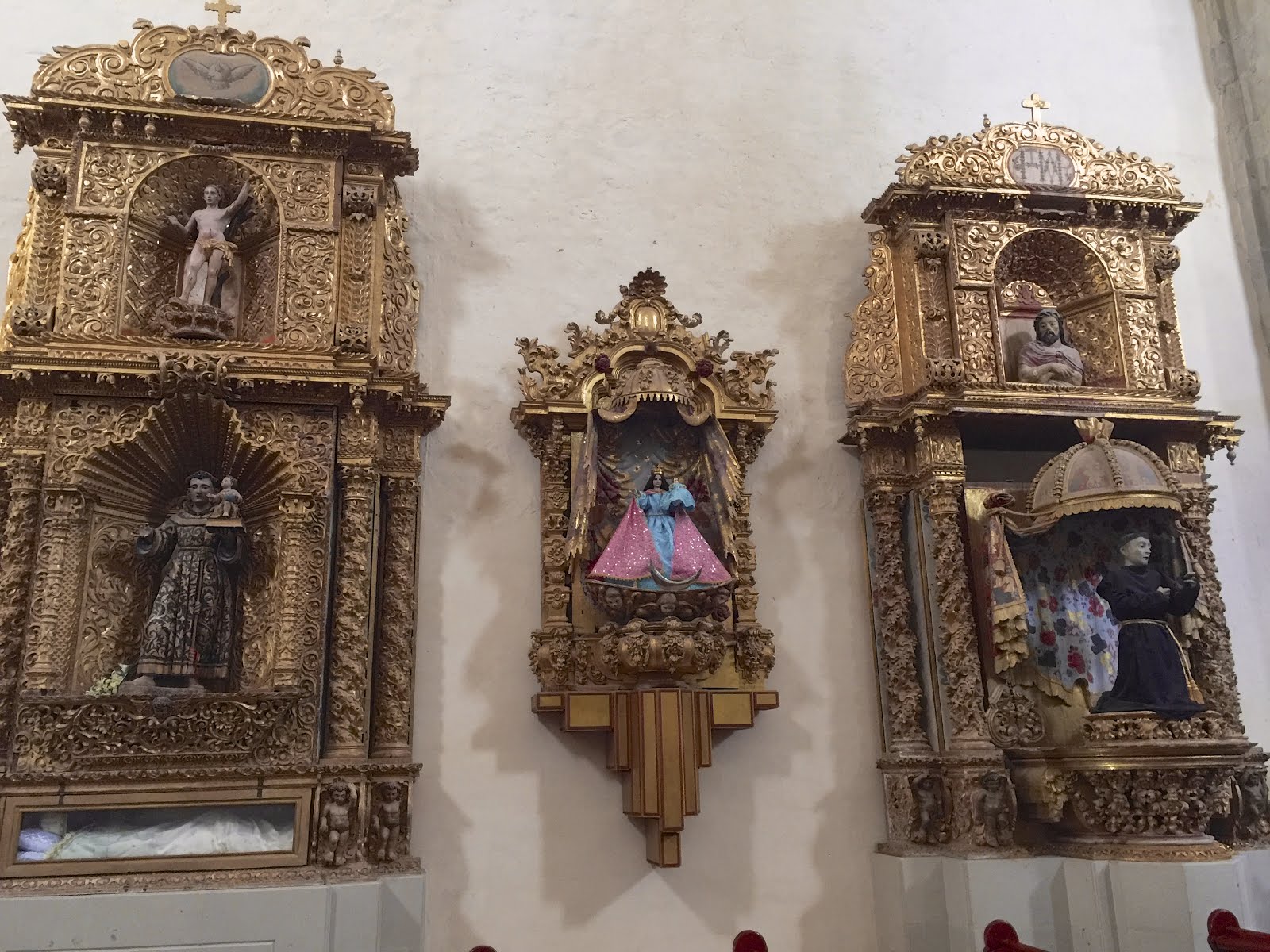
The church has numerous other side altars in styles ranging from neoclassical to baroque.

Teposcolula, Side Altar


Teposcolula, Side Altar


Teposcolula, Side Altar
                                                   

Teposcolula, Side Altar


Teposcolula, Side Altar


Teposcolula, Side Altar
                                   
The church's organ is located high on a side wall of the church toward the rear, an unusual placement for a church organ.  Conceivably, it could be related to the lofts in the open chapel.

Teposcolula, Church Organ

Teposcolula, Church Interior showing placement of Organ
                                               

As in most churches in Oaxaca, there is a characteristic statue of Jesus riding on a donkey, an image derived from Palm Sunday.  
                                   

Teposcolula, Church-Image of Jesus on Donkey


In contrast to the ornamental ceiling in the Coixtlahuaca monastery with its ribbed and painted ceiling, Teposcolula's vaulted ceiling is quite plain, as seen below

Teposcolula, Church Ceiling
                                               

 Representations of the four Evangelists next to the altar dome are a notable for their style. The indigenous hand in their painting is clear and forms a contrast to the European sophistication of the rest of the architecture and decoration.


Teposcolula, Altar Dome
                                             

Teposcolula, Image of San Juan (St. John)


Teposcolula, Image of San Marcos (St. Mark)


The Convento:

The monks' living quarters, the convento, is located adjacent to the church to its right in the photo above, where part of it's entrance can be seen.
Teposcolula church

Teposcolula, Convento Entrance

Teposcolula, Church seen from Convento Courtyard


Teposcolula, Convento Courtyard


Teposcolula, Exterior Passageway and Convento Courtyard


There has been considerable restoration of the convento's interior.  Originally, the interior was ornamentally painted and some of this has been put back into its original condition, which was not the case in Coixtlihuaca.  
                                         
Teposcolula, Convento Staircase
                                  
                             
Teposcolula, Convento Interior Decorative Painting


Teposcolula, Convento Interior Decorative Painting
                                                

Teposcolula, Convento Interior Decorative Painting


The Saint Gertrude Chapel is located in the front of the convento and is said to have been the place where the friars were buried.  


Teposcolula, St. Gertrude Chapel
                                               

Tecpan/ Casa de la Cacica:

Built in the 1560's, this casa de la cacica, house of the indigenous nobility, is the most complete one surviving in Oaxaca and is undergoing restoration at the present time. These palaces for indigenous nobility were built on monastery grounds as a part of the evangelization process.  Typically, local nobility would be the first to convert to Christianity and their presence on monastery grounds was an encouragement for their subjects to follow suit and become Christians. 

                                   
Teposcolula, Tecpan


Teposcolula, Tecpan with Disc Frieze


The disc frieze on the tecpan is in the pre-hispanic style and what it represents has been a source of speculation; some scholars have suggested that it depicts hallucinogenic datura or morning-glory flowers.  Such flowers are found in indigenous-related artwork throughout Mexico. 
                                               ______________________

San Pedro y San Pablo Teposcolula is best visited in conjunction with the monasteries of Yanhuitlan and Coixtlihuaca. Although the three share many architectural features each has a distinct personality and features.  Both Teposcolula and Yanhuitlan have undergone extensive restoration being returned to a pristine state;  Coixtlihuaca has not been restored and retains more of a feeling of authenticity.


Wednesday, June 8, 2016

Ruta Dominica (Dominican Route) of Oaxaca: San Juan Bautista Coixtlahuaca

San Juan Bautista, Coixtlahuaca, Church West Façade
The work of colonial-era Mixtec stone-carvers and artisans lives untouched in this old monastery in the Mixteca Alta.  This mountainous area, the Mixteca Alta, lying to the northwest of Oaxaca City is home to a group of great 16th century Dominican monasteries built long ago to further the evangelization of Oaxaca. One of them, the magnificent Santo Domingo de Yanhuitlan, has already been explored in this blog (May 20, 2013). The  long (1/12-2 hours) car ride to this rugged area is worthwhile and can be done as a day trip.  San Juan Bautista, Coixtlahuaca is the earliest and least changed of the great Dominican monasteries of the Mixteca Alta.  The Dominicans arrived here in the 1540's and by 1570 the buildings were completed. (note: please click on photos and they will enlarge).


Grounds-plan:

All the monasteries were built in a similar pattern. The open chapel was the first structure to rise up, built to further the evangelization of a people who did not have a concept of indoor worship,  then the church and the cloister (convento) to house the monks. Looking head on at the Coixtlahuaca complex, the hexagonal open chapel is seen at the very left, separated by a small distance from the church, which is next to it, viewer-right, and next to and attached to the church is the monastery's convento or cloister, the monks' residence. At a distance from the church/convento complex was what was called the casa de la cacica or in the Mixtec language, tecpan, something not seen in other areas of Oaxaca.  In the Mixtec- controlled areas, the local indigenous nobility still played a significant role in the early colonial community and this tecpan was built to house the local chief. In general, this person was the first to convert to Christianity and his presence on the monastery grounds was a symbolic encouragement for his people to follow suit and accept the new religion.


San Juan Bautista, Coixtlahuaca, Open Chapel


San Juan Bautista Coixtlahuaca,  North façade of church


San Juan Bautista, Coixtlahuaca, Convento entrance

San Juan Bautista, Coixtlahuaca, Church seen from interior courtyard of convento


Open Chapel:

This chapel, built in 1546, was the earliest part of the monastery.  The polygonal vault which once covered it has collapsed and it is now open to the sky.

San Juan Bautista, Coixtlahuaca, Open Chapel


The chapel is characterized by bands of tequitqui carving, a syncretic style that included both indigenous and Christian symbols. Tequitqui carving tended to have a flattened appearance resembling that of pre-Hispanic carving styles.  

San Juan Bautista, Coixtlahuaca, Open Chapel rib detail

In the following photo eagle-like pelicans intertwine with plumed rattlesnakes.


San Juan Bautista Coixtlahuaca, Open Chapel rib carving


The presence of the indigenous symbols in this new house of worship was powerful for the new converts forming a bridge to their old religion and its temples.


The Church:

Exterior:


The church building is not ornamented apart from its two doors.  The north door was the one  used in processions in the early Colonial period.


San Juan Bautista Coixtlahuaca, West Façade of Church
                                       
Three large statues are carved above the door in a style that clearly reflects the work of the indigenous carvers. St. John the Baptist, the monastery's patron saint, is in the center flanked by Saints Peter and Paul. Above these is a Gothic rose window with intricate carving on either side. 


San Juan Bautista Coixtlahuaca, North Façade of  Church


On both sides of the upper façade are intricate carvings of the elements of Christ's Passion, as seen in the photo below.                                        
                                             
San Juan Bautista, Coixtlahuaca, North Façade - Elements of the Passions
                                                
The west door and facade are more classical in style, but contain tequitqui elements.
In particular, the triangular element above the door consists of the Spanish coat of arms 
surrounded by the two-headed Hapsburg eagle, an animal that had strong indigenous resonance. The church has a single tower.


San Juan Bautista Coixtlahuaca, West Façade
                                                      

San Juan Bautista, Coixtlahuaca, North Door of Church


Interior:

San Juan Bautista, Coixtlahuaca, Church Interior seen from Choir
                                                                                                       

San Juan Bautista, Coixtlahuaca, Main Retablo
                                                       

This main retablo has fourteen painted panels many of which are attributed to Andres de Concha a Spanish master from Seville.  Simon Peyrens, the Flemish sculptor, may have done some of the carving on the altarpiece.  Here is the arrangement of the paintings in this retablo, from the top down, in rows: (photo will enlarge when clicked).

                                                              God the Father
                                                    St. Anne, Trinity, St. Joachim
                                                    Ascension, Crucifixion, Resurrection
                                                    Presentation in the Temple, Three Kings
                                                    Adoration of the Shepherds, Annunciation


Church Ceiling:

San Juan Bautista, Coixtlahuaca, Church Ceiling


San Juan Bautista, Coixtlahuaca, Church ceiling ribbing


San Juan Bautista, Coixlahuaca, Church ceiling Roof Boss
                                                                                     

The church's ribbed ceiling is unique with the molded, painted ribs and the tequitqui carved roof bosses. Each contains miniature portraits of saints and their symbols.  


The Convento:

The convento is located alongside the church building of the Coixtlahuaca monastery.
Only the lower is intact, although it is possible to visit parts of the upper level which over the years has been damaged by earthquakes.  Some reconstruction is on-going on this second level.


San Juan Bautista, Coixtlahuaca, Convento entrance


San Juan Bautista, Coixtlahuaca, Convento Door and Façade
                                                 
The convento is located directly next to the church and the two buildings share a wall.
                                              
San Juan Bautista, Coixtlahuaca, Church-Convento shared wall
                                              
San Juan Bautista, Coixlahuaca, Convento Courtyard

As many early colonial Mexican buildings, Coixtlahuaca's convento shows mudejar  (derived from Islamic architecture ) details in features of the building such as the door and window below.


San Juan Bautista, Coixtlahuaca, Convento Corridor
          

San Juan Bautista, Coixtlahuaca, Convento Mudejar-style Door
             

San Juan Bautista, Coixtlahuaca, Mudejar Window

In parts of the Coixtlahuaca convento, remnants of the original wall frescos remain.
                
San Juan Bautista, Coixlahuaca, original fresco 


The Tecpan:

The building in the old photograph below, the tecpan or casa de la cacica, was the home of the indigenous noble who led the community and encouraged the conversion effort.  This building, which no longer exists, was torn down and the bricks used to build another building for the modern community. It was built with considerable ornamental detail, as can be seen in the second photo.


San Juan Bautista, Coixtlahuaca, Tecpan (no longer in existence)


San Juan Coixtlahuaca, Tecpan architectural detail
         
Although the neighboring monastery at Yanhuitlan has been elegantly restored and the one at Teposcolula is undergoing extensive restoration, San Juan Bautista, Coixtlahuaca retains an aura of authenticity because it has not been restored.   I visited both Coixtlahuaca and Teposcolula in the same day and the former, by far, was my favorite.  INAH, the Mexican government bureau which oversees archaeological and historical sites, has a representative in all major monasteries.  Here, at Coixtlahuaca, this representative was extremely gracious and helpful and unlocked the choir loft of the church giving me the chance to access an incredible perspective on the old church as well as offering information and photos of the no longer existant tecpan