Pages

Showing posts with label Oaxaca. Show all posts

Monday, October 21, 2019

Dia de los Muertos is Almost Here


Grave decorated for Dia de los Muertos, Oaxaca, MX
Dia de los Muertos Altar, Oaxaca, MX
Dia de los Muertos door decoration, Oaxaca MX
Dia de los Muertos Altar Items for Sale, Oaxaca MX
Dia de los Muertos, roughly Oct. 31-Nov.2, is fast approaching.  It is one of Mexico's most colorful holidays and a fabulous time to visit Mexico, if you can.   But if events keep you at home this year, you can enjoy the holiday second hand through this post. Please follow the link to see Dia de los Muertos as it is celebrated in different parts of Mexico.  Included is a link to a video of a rarely seen observation of the holiday in San Juan Chamula, Chiapas.

I hope you enjoy Dia de los Muertos as much as I do!

Wednesday, October 24, 2018

Take a Tour of Dia de los Muertos Without Leaving Your Home

Items for Dia de los Muertos Altars, Oaxaca, MX
Dia de los Muertos links the living and the dead for a short while, October 31-November 3, and is one of the visually most striking celebrations in all of Mexico.  Click this link and take a tour of Dia de los Muertos throughout Mexico.
https://colonialmexicoinsideandout.blogspot.com/2017/10/a-dia-de-los-muertos-odyssey.html


Man with relative's skull, Pomuch, Campeche, MX

By far, the most unique Dia de los Muertos is in Pomuch in the state of Campeche, where they actually take out the bones of dead ancestors to clean them, as seen above.
https://colonialmexicoinsideandout.blogspot.com/2016/12/pomuch-campeche-dia-de-los-muertos-you.html

Hope you enjoy your tour!


Monday, July 30, 2018

Oaxaca Comes to Life in a Procession: a new video

Add caption
This past February I wrote about a colorful group reunion that took the form of a procession on the streets of Oaxaca City.  https://colonialmexicoinsideandout.blogspot.com/2018/02/a-reunion-oaxaca-style.html.  I have now have made a video of this event, which brings the beautiful Tehuana costumes to life and gives viewers an opportunity to see the incredible Colonial architecture of the city as the procession moves along its streets.

 My video is available at: https://www.youtube.com/watch?v=ygn9Vth640M.


Thursday, October 19, 2017

A Dia de los Muertos Odyssey


Cemetery decorated for Dia de los Muertos, Romerillo, Chiapas
Dia de los Muertos, the time of year in Mexico when the worlds of the living and dead intersect, is coming up.  According to the lore of the holiday, on November 1 and 2, the souls of the dead visit and partake of the lives they once lived on earth. Preparations to welcome the dead begin well before these days and in many places Halloween (Oct. 31) is included in the celebration. 

Each region of Mexico contributes its own specific beliefs and customs to this pan-Mexican holiday. Our odyssey, here, begins in Chiapas, Mexico with its unique contribution of pre-Columbian Maya beliefs and customs.  The green crosses in the photo above are typical of Maya areas and have a local meaning and symbolism beyond that of the Christian cross.  In Romerillo Chiapas, people place boards over graves so that the dead during the year, so they cannot leave them and wander around before Dia de los Muertos.


Grave in Cemetery of Romerillo, Chiapas
Read all about Dia de los Muertos as it is celebrated in Chiapas:
https://colonialmexicoinsideandout.blogspot.com/2013/11/dia-de-los-muertos-chiapas.html


Dia de los Muertos, Cemetery San Juan Chamula, Chiapas
You can see it, as well, in the Videos linked below. The first one I shot at the November 2 celebration in the cemetery of San Juan Chamula, Chiapas. It is one of a kind and you will be treated to an event not usually seen by outsiders, since photography is forbidden ( I had special permission)
A second video is of the celebration in the beautiful cemetery of Romerillo shown in  two of the photos above.  
The third video is of the Panthéon (cemetery) of Cristöbal de las Casas.  Cemeteries are hubs of activities during Dia de los Muertos and this video captures the beauty and poignancy of the celebration.
https://colonialmexicoinsideandout.blogspot.com/2013/11/videos-of-dia-de-los-muertos-in-chiapas.html


Add caption
In the states of Quintana Roo and Yucátan there are unique twists to Dia de Los Muertos where the holiday is known by its Maya name of Hanal Pixán.
https://colonialmexicoinsideandout.blogspot.com/2014/11/dia-de-los-muertos-hospitality-for-dead.html


Add caption
In parts of the US once owned by Mexico, elements of Mexcian culture are still vibrant.
Here are two videos shot in the Spanish missions of San Antonio, Texas, which was once a part of colonial Mexico. They show the unique blending of indigenous American and Mexican-Christian elements in this Dia de los Muertos celebration.
https://colonialmexicoinsideandout.blogspot.com/2015/10/coahuiltecan-indian-blessing-of-dia-de.html


Dia de los Muertos revelers, Oaxaca

Oaxaca is justifiably famous for its celebration of Dia de los Muertos.  People painted as skeletons, portraying La Catrina the icon of Dia de los Muertos, are everywhere.  Is this all fun and games?  No, there is a much deeper level to all the rollicking activity, as you will learn here:
https://colonialmexicoinsideandout.blogspot.com/2015/11/dia-de-los-muertos-in-oaxaca-rehearsal.html


Open Grave in Cemetery of Pomuch, Campeche
Pomuch, a small town in Campeche, hosts what I call the "Ultimate" Dia de los Muertos". 
It's a little shocking, at first, but fascinating.
https://colonialmexicoinsideandout.blogspot.com/2016/12/pomuch-campeche-dia-de-los-muertos-you.html

                                       ----------------------------------------------

Mexico is wonderful any time of the year. During  Dia de los Muertos it is most itself with its essential nature, the unique blending of indigenous and Christian elements, shining through.


Tuesday, August 8, 2017

Eat and Drink Like an Aztec (or Inca)

Guinea Pig
The thought of eating your child's classroom pet, like this adorable guinea pig, is bound to be upsetting.  Yet guinea pigs were and remain a popular protein source in Peru and elsewhere in the Andean area that was once home to the Incas and other Quechua-speaking peoples.  At least by local standards they are delectably prepared, skewered with rosemary and baked in wood-burning ovens. Crispy and succulent when roasted,  live guinea roam the kitchens of Andean homes awaiting their turn in the oven.


Roasted Guinea Pigs, Pisac, Peru


Roasted Guinea Pigs, Pisac, Peru

 Pre-Columbian Mesoamerican protein sources were different from ours, because our food animals like cows, sheep, goats and pigs were not native to the Americas, only arriving from Europe with the Spanish Conquest. Mexico has more edible insects than any other place in the world and good use is made of them.  Insect-eating is rooted deep in its Pre-columbian past and is very much alive today.

 if you find bugs in your guacamole in Oaxaca, don't send it back- they are supposed to be there and you are probably paying extra for them. These fried grasshoppers give crunch and texture to the dish and guacamole with chapulines is a signature dish of the region.

Insects, typically fried and dusted with various flavorings such as chile, lime or garlic are sold in markets in throughout Mexico.  People buy them by the bag to munch on and they are a healthy snack because they are almost pure protein.  They also show up in tacos and incorporated into various dishes.  


Assorted Fried Insects, Oaxaca, MX
Fried Grasshoppers with Chile, Oaxaca, MX

Fried Insects at Market, Cholula, Puebla MX
Fried Grasshoppers, Cholula, Puebla MX                
Mexico has some 300-550 edible insects according to the UN Food and Agriculture Organization, all sustainable sources of protein. These include grasshoppers 
(chapulines), flying ants (chicatanas), honeypot ants (hormigas de miel), ant larvae (escamotes or ahuatle), dragonflies (libélulas), crickets (grillos).    And don't forget about the crawlers because worms and caterpillars are also popular. 

Pictured below are the popular gusanos, maguey worms, that are an important ingredient in some moles and are also eaten fried on tacos.                         


Gusanos, Mexico City MX
 Drink:

Pulque, a low-alcohol drink made from the fermented sap of the agave (maguey) plant, has a history in Mexico that is longer than a millennium.  Originally, it was a sacred drink and its use limited to certain classes of people.  After the conquest it became a popular drink 
for all.   Pulque is low alcohol, about the same percentage as beer, and has health, even medicinal, benefits and is used in hospitals with anemic patients to raise their red blood counts.  It is my personal favorite, as well.

Production of pulque is labor and time-intensive, with the slow-growing agave plants needing twelve years to mature.  The fermentation process of pulque is on-going so it must be consumed soon after it is produced, which is why it is not exported.  

From my experience, there is a regional variance in pulque.  Pulques in Oaxaca 
tend to be clear and slightly fizzy, whereas in the state of Mexico, the pulque is cloudy, 
more viscous and comes with different flavorings. 


Pulqeria,Mexico City, MX
The photo above is from a popular pulqueria in Mexico City.  As can be seen, their 
pulques are offered in several flavors- oatmeal, peanut, pineapple, pine nut, guava  and others. Consuming pulque is a leisurely pursuit and people come to pulquerias to sit, visit and enjoy the snacks offered.


Pulqueria, Mexico City MX
Pulqueria, Mexico City ,,MX

Below are typical presentations of pulque in Oaxaca, where it often is sold at weekly markets in small towns around the city. The second container labelled tepache is another drink, low alcohol,  made form the fermented rinds of pineapples.  The process is much faster than that of pulque, taking only a few days. Its origins are pre-Hispanic, but it never had the significance of pulque.    


Typical Pulque and Tepache container, Oaxaca MX


Pulque vendor, O


Pulque vendor, Oaxaca MX

Atole, seen being made below, is another popular Mexican beverage with pre-Hispanic origins.  It is made from ground corn (masa), sugar, cinnamon, with other flavorings such as chocolate sometimes added. It is stirred with bare hands and served to customers in small bowls.


Atole in process in market, Oaxaca, MX
Buen Provecho!                       

Wednesday, August 3, 2016

Ruta Dominica (Dominican Route) of Oaxaca: San Pedro y San Pablo Teposcolula

San Pedro y San Pablo, Teposcolula Oaxaca


This is the third post in a series about the grand 16 th century Dominican Monasteries of Oaxaca's Mixteca Alta, the mountainous area lying to the northwest of Oaxaca City.  The other two that have been covered are San Juan Bautista Coixtlahuaca (June 8, 2016) and San Juan Yanhuitlan (May 20, 2013).  The car ride to the area is fairly long (11/2 to 2 hours), but the mountainous scenery along the route is striking and the trip can be done in one day.  

The Dominicans arrived in Teposculala from Yanhuitlan in 1538 introducing industries which led to a rapid development of the area, although after 1576 there was a decline in the area due to, among other things, an large epidemic among the indigenous inhabitants.

Monastery Plan:

Atrium:

All monasteries in the New world followed the same basic plan.  Each was located on a large plot of land surrounded by a wall, the atrium, which typically had a cross in the middle of it. Until a monastery's buildings were built, religious services were held in open air in the atrium; the indigenous peoples were accustomed to outdoor worship.

                                        
Teposcolula: Atrial Cross

Teposcolula, Wall enclosing Atrium

                                                 
Open Chapel:

In all new world monasteries, the first structure to go up was the open chapel, built to  evangelize the indigenous peoples who did not have a concept of indoor worship. Scholars believe that open chapels were intentionally built to evoke the prehispanic teocalli, the ancient temples built on top of pyramids, found in prehispanic Mesoamerican cultures. 

 The Teposcolula open chapel, dedicated to John the Baptist, is considered one of the masterpieces of Colonial Spanish architecture.  Likely, modeled on the one in the monastery in Coixtliahuaca,  it was built on a grand scale with a second story and all of it, including its Gothic star vault, has been restored.


Teposcolula, Open Chapel
                                 

Teposcolula, Open Chapel
                                       

Teposcolula, Open Chapel Dome
                                     
Teposcolula, Open Chapel Dome


Teposcolula, Open Chapel altar
                                   

Teposcolula, Open Chapel, showing upper story


              The Church:

Teposcolula, Church Façade

The church was largely rebuilt in the 18th century due to earthquake damage. Although Teposcolula was a Dominican monastery, The façade has representations of both Franciscan and Dominican personages.

Teposcolula Church Façade, Dominican Saint
                                           
Teposcolula Church Façade, St. Clare (Franciscan Nun)


The original altar, dating grin 1581 disappeared and was replaced with a neoclassical altarpiece.


Teposcolula, Church Interior


Teposcolula, Front Altarpiece
                                               
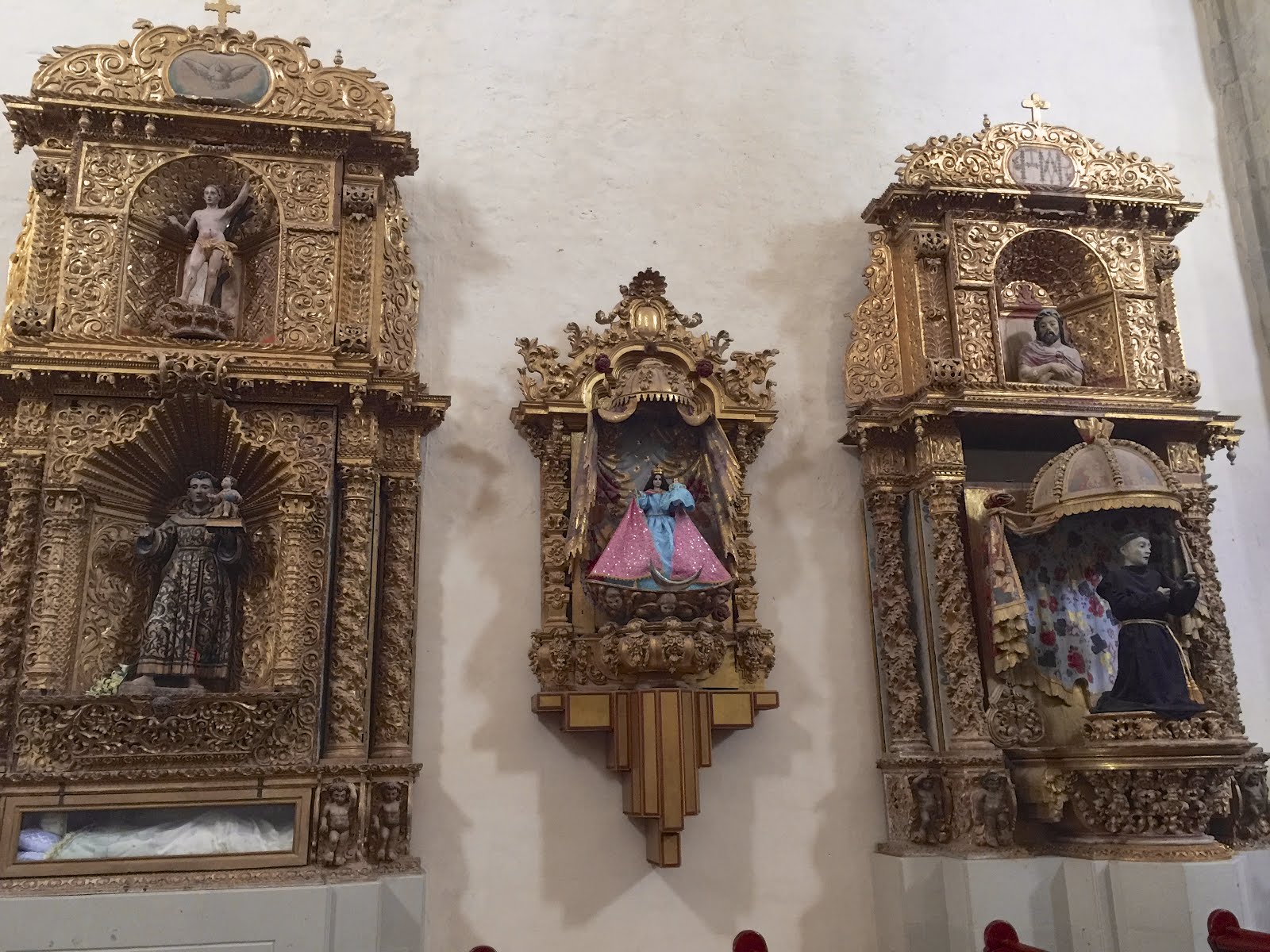
The church has numerous other side altars in styles ranging from neoclassical to baroque.

Teposcolula, Side Altar


Teposcolula, Side Altar


Teposcolula, Side Altar
                                                   

Teposcolula, Side Altar


Teposcolula, Side Altar


Teposcolula, Side Altar
                                   
The church's organ is located high on a side wall of the church toward the rear, an unusual placement for a church organ.  Conceivably, it could be related to the lofts in the open chapel.

Teposcolula, Church Organ

Teposcolula, Church Interior showing placement of Organ
                                               

As in most churches in Oaxaca, there is a characteristic statue of Jesus riding on a donkey, an image derived from Palm Sunday.  
                                   

Teposcolula, Church-Image of Jesus on Donkey


In contrast to the ornamental ceiling in the Coixtlahuaca monastery with its ribbed and painted ceiling, Teposcolula's vaulted ceiling is quite plain, as seen below

Teposcolula, Church Ceiling
                                               

 Representations of the four Evangelists next to the altar dome are a notable for their style. The indigenous hand in their painting is clear and forms a contrast to the European sophistication of the rest of the architecture and decoration.


Teposcolula, Altar Dome
                                             

Teposcolula, Image of San Juan (St. John)


Teposcolula, Image of San Marcos (St. Mark)


The Convento:

The monks' living quarters, the convento, is located adjacent to the church to its right in the photo above, where part of it's entrance can be seen.
Teposcolula church

Teposcolula, Convento Entrance

Teposcolula, Church seen from Convento Courtyard


Teposcolula, Convento Courtyard


Teposcolula, Exterior Passageway and Convento Courtyard


There has been considerable restoration of the convento's interior.  Originally, the interior was ornamentally painted and some of this has been put back into its original condition, which was not the case in Coixtlihuaca.  
                                         
Teposcolula, Convento Staircase
                                  
                             
Teposcolula, Convento Interior Decorative Painting


Teposcolula, Convento Interior Decorative Painting
                                                

Teposcolula, Convento Interior Decorative Painting


The Saint Gertrude Chapel is located in the front of the convento and is said to have been the place where the friars were buried.  


Teposcolula, St. Gertrude Chapel
                                               

Tecpan/ Casa de la Cacica:

Built in the 1560's, this casa de la cacica, house of the indigenous nobility, is the most complete one surviving in Oaxaca and is undergoing restoration at the present time. These palaces for indigenous nobility were built on monastery grounds as a part of the evangelization process.  Typically, local nobility would be the first to convert to Christianity and their presence on monastery grounds was an encouragement for their subjects to follow suit and become Christians. 

                                   
Teposcolula, Tecpan


Teposcolula, Tecpan with Disc Frieze


The disc frieze on the tecpan is in the pre-hispanic style and what it represents has been a source of speculation; some scholars have suggested that it depicts hallucinogenic datura or morning-glory flowers.  Such flowers are found in indigenous-related artwork throughout Mexico. 
                                               ______________________

San Pedro y San Pablo Teposcolula is best visited in conjunction with the monasteries of Yanhuitlan and Coixtlihuaca. Although the three share many architectural features each has a distinct personality and features.  Both Teposcolula and Yanhuitlan have undergone extensive restoration being returned to a pristine state;  Coixtlihuaca has not been restored and retains more of a feeling of authenticity.